AI Humanizer · tutorials
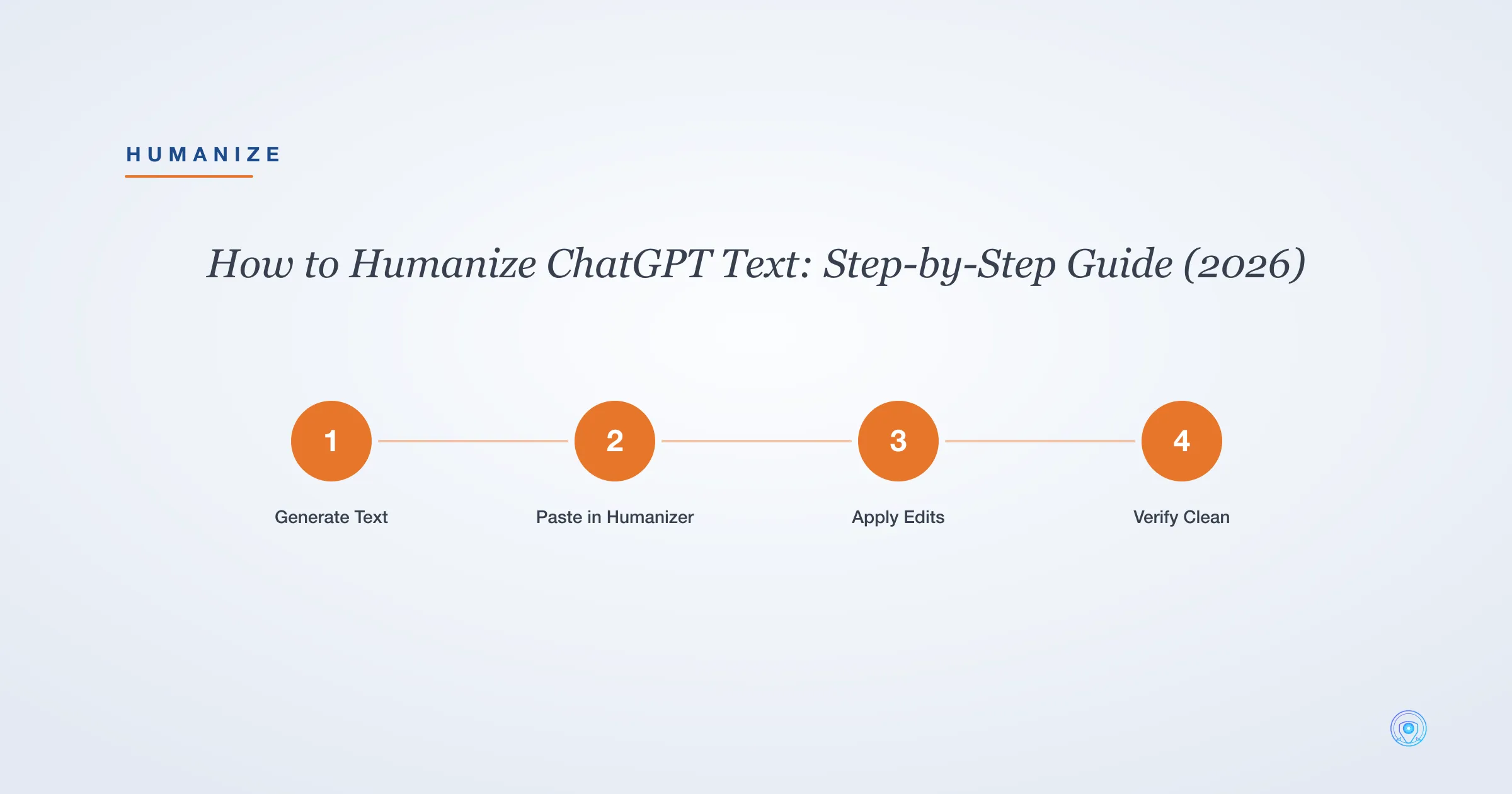
How to Humanize ChatGPT Text: Step-by-Step Guide (2026)
Three working methods to humanize ChatGPT output and pass AI detectors. Tool-assisted, manual, and hybrid workflows with worked examples.

ChatGPT is good at producing readable English. It is also good at producing readable English that AI detectors flag immediately. This guide walks through three methods to fix that — tool-assisted, manual, and hybrid — and shows worked examples for each.
The aim is not to make ChatGPT “undetectable forever.” Detectors update weekly. The aim is to get a draft that passes today’s detectors with the meaning intact, in a workflow you can repeat.
Why ChatGPT text gets flagged
A detector does not “know” your text was written by ChatGPT. It scores three things:
- Perplexity — how predictable the next word is. ChatGPT picks the statistically most likely next word, so perplexity stays low.
- Burstiness — how much sentence length varies. ChatGPT tends to write in a metronome rhythm.
- Vocabulary fingerprints — overuse of “leverage,” “delve,” “navigate,” “in today’s,” “it is important to note” and similar tells.
When a passage scores low on perplexity, low on burstiness, and contains the wrong vocabulary clusters, the detector verdict is “AI.” A humanizer’s job is to disrupt all three signals at once without breaking your argument. For the long version of the math, see our perplexity guide.
StealthZero humanizer numbers (verified)
Five rewrite models, four pricing tiers, and a 100-word floor on Sentrio scoring. Free tier covers 600 rephrase requests per month at a 20-per-day cap. Auto Agent Rephrase batches documents up to 12,000 words in a single task.
- Free plan: 600 requests/month, 20/day cap, unlimited words per request
- Starter ($9.99/mo): unlimited Origin + 1,500 advanced (Sentinel + F.R.I.D.A.Y + Jarvis) requests
- Pro ($19.99/mo): 3,000 advanced requests, 100/day cap, 2 AI Reports/month
- Premium ($29.99/mo): unlimited everything, 3 AI Reports/month, 5 Auto Agent credits
- Auto Agent Rephrase add-ons: Mini ($3.99, 2,000 words), Pro ($6.99, 5,000 words), Max ($12.99, 12,000 words)
- Liang et al. 2023 (arXiv:2304.02819) documented over 60% false-positive rates for ESL writers across mainstream GPT detectors
Weber-Wulff et al. 2023 (Int J Educ Integr 19:26) benchmarked 14 detection tools and found none reached the accuracy needed to be considered reliable in academic integrity workflows — most tools either over-flagged human writing or missed machine-paraphrased AI text.
Method 1: Tool-assisted humanization (recommended)
This is the workflow most people should use. Total time end-to-end is under 60 seconds for a 1,000-word draft.
Step 1 — Generate your draft
Use ChatGPT (or Claude, Gemini, any LLM) to produce a complete draft of the content you need. Quality in, quality out. A weak prompt produces a weak draft, and the humanizer cannot fix weak reasoning.
Step 2 — Read it once
Before humanizing, read the draft and fix anything factually wrong, off-brief, or missing a citation. A humanizer rewrites the surface; it does not rescue bad substance.
Step 3 — Open the humanizer and configure it
Open StealthZero’s humanizer and paste the draft. Configure three settings before you click rewrite:
- Model — Origin is free and unlimited, good for casual content. Cohera (Jarvis sub-model) is the strongest rewrite, useful when stakes are high. Sentinel-Lite and Sentinel-Max sit in between.
- Tone — pick the register you actually want (Neutral, Casual, Academic; Cohera also has Professional, Formal, Conversational, Creative).
- Locked phrases / protected keywords — paste any citation, number, quote, name, or technical term that must not change. The rewriter will route around these.
Step 4 — Run the rewrite
Click humanize. For typical inputs (500–2,000 words), StealthZero returns in 3–8 seconds. Read the output side-by-side with the input.
Step 5 — Verify with a detector
Before you ship, run the humanized output through a detector. StealthZero’s E.D.I.T.H detector is built into the humanizer flow; results show inline.
If the stakes are high (school submission, journal, client deliverable), export a Proof Report — the PDF includes Turnitin, GPTZero, Winston and Copyleaks scores in one document. Free plan does not include Proof Reports; Starter/Pro/Premium include 1/2/3 per month, plus add-on packs.
Step 6 — Add your fingerprints
The humanizer does not know what you specifically would say. Add one or two details only you would write — a personal example, a specific number from your own experience, an aside that sounds like you. That last pass is what closes the gap between “human-ish” and “you.”
Worked example
ChatGPT draft:
“AI detection tools have become increasingly important in today’s digital landscape. These tools leverage advanced algorithms to identify content generated by large language models, allowing institutions to maintain academic integrity and content authenticity.”
StealthZero output (Cohera, Professional tone, “make academic integrity” locked):
“AI detection tools matter more now than they did a year ago. They use trained classifiers that look for statistical fingerprints in text — patterns of word choice and sentence length that line up with output from large language models. Institutions use them to maintain academic integrity, and publishers use them to vouch for what they print.”
Same idea. Higher perplexity (specific words like “trained classifiers,” “statistical fingerprints”). More burstiness (the second sentence is twice as long as the third). The locked phrase “academic integrity” carries through unchanged.
Method 2: Manual humanization (slow, free, voice-perfect)
If you prefer to do it by hand — or you only have a paragraph and the friction of opening a tool is not worth it — the manual workflow looks like this. Budget 30–60 minutes per 1,000 words.
Step 1 — Vary sentence length, intentionally
ChatGPT writes 18–22 word sentences in a row. Break that. The rule of thumb: every fourth or fifth sentence should be short (under 8 words). Every now and then, one sentence should be long enough that it carries multiple clauses and a turn in the middle.
Before:
“The model processes the input. It generates an output. The output is then evaluated. The user can refine the output.”
After:
“The model processes the input and produces an output. You read it. If it is wrong, refine the prompt and try again — that loop is the whole game.”
Step 2 — Replace the AI vocabulary
| ChatGPT default | Human alternative |
|---|---|
| utilize | use |
| leverage | use |
| crucial | important (and explain why) |
| comprehensive | full / complete |
| robust | strong |
| delve into | look at |
| furthermore | also |
| in today’s [X] landscape | (delete the phrase entirely) |
| it is important to note | (delete) |
| navigate | (delete; describe the actual action) |
This single change does more than any other manual edit. Detectors weight vocabulary fingerprints heavily.
Step 3 — Add specificity
Generic ChatGPT statements get replaced with specific ones. “Many users report success” becomes “Our writer Sarah cut her draft time from four hours to forty minutes.” If you cannot add a specific, your draft is too thin.
Step 4 — Break perfect grammar (slightly)
Start a sentence with “And” or “But” once or twice. Use a fragment. Add a contraction. These are normal human moves; ChatGPT avoids them by default.
Step 5 — Cut the conclusion’s restatement
ChatGPT loves a closing paragraph that restates the opener. Delete it. End on a specific.
Limits of the manual method
Manual works, but two things go wrong:
- You miss your own tells. If “delve” is part of your vocabulary, you will not flag it. The tools have lists you do not have.
- You over-correct. Beginners add typos to “look human.” Detectors are not fooled by typos. They are fooled by varied perplexity. A typo is just noise.
Method 3: The hybrid workflow (for important content)
When stakes are high (thesis chapter, journal submission, large client deliverable), combine the two methods. Time budget: about 5 minutes per 1,000 words.
- Generate the draft with ChatGPT or Claude.
- Quick manual pass — replace the obvious slop vocabulary (the table above), add one specific example you would not have written otherwise.
- Run the humanizer with locked phrases for all citations, numbers, names and direct quotes. Pick the Cohera model for academic content; Origin or Sentinel for marketing/blog content.
- Verify with a multi-detector Proof Report. If anything flags, fix that specific passage and rerun.
- Final read-through out loud. If a sentence does not sound like you when read aloud, edit it.
This is the workflow we recommend for anyone whose work will be scored against Turnitin or read by an editor who runs Originality.ai checks.
What does not work?
A few approaches show up in Reddit threads. They do not work.
- Running the text through three paraphrasers in a row. Output quality collapses fast, meaning drifts, and the detector still flags it. Detectors look at structural patterns the paraphrasers do not change.
- Asking ChatGPT to “make this sound more human.” ChatGPT’s idea of “more human” is its default style with contractions added. Detectors still flag it.
- Adding deliberate typos. Typos look human. They do not change perplexity or burstiness, which is what the detectors actually score.
- Translating to French and back. This sometimes used to work in 2023. Modern detectors are robust to it.
Sadasivan et al. 2023 (arXiv:2303.11156) showed that even the strongest AI text detectors degrade toward random-chance accuracy under light paraphrasing attacks, suggesting a theoretical ceiling on reliable detection of high-quality AI text.
Comparing manual vs tool-assisted vs hybrid
| Approach | Time per 1,000 words | Typical pass rate | Best use case |
|---|---|---|---|
| Tool only (StealthZero) | < 1 minute | Targets 99 percent on standard flow; Cohera reaches 100 percent in internal testing | Everyday content |
| Manual only | 30–60 minutes | Variable — depends on the writer’s skill | Short passages, voice-critical writing |
| Hybrid (recommended for high stakes) | ~5 minutes | Same as tool, plus voice fidelity from manual pass | Thesis chapters, journal articles, large client deliverables |
The numbers cited for StealthZero are operator-verified. The numbers for manual rewriting depend entirely on the person doing the rewriting; we are not going to invent a benchmark for that.
Verification — close the loop
Whichever method you use, end with a verification step. Otherwise you are guessing.
Quick verification: paste the output into StealthZero’s detector. The E.D.I.T.H model is calibrated against real-world Turnitin scores; Sentrio v2 has four stricter modes (Standard, Aggressive, Multilingual, Scholar — Sentrio requires at least 100 words).
Full verification: generate a Proof Report. The PDF runs the text through Turnitin, GPTZero, Winston and Copyleaks and produces one document with all four scores. If you are submitting to an institution, that PDF is your receipt.
For a deeper walkthrough on the Proof Report flow, see our Turnitin AI report guide.

Common questions
Does this work for every model, not just ChatGPT?
Yes. Detectors look at statistical fingerprints, not model-specific signatures. A humanizer that works on ChatGPT output works on Claude, Gemini, Llama, and Mistral output too. The patterns are the same.
Can I humanize a very long document?
StealthZero’s Free plan caps requests at 600/month with 20/day; there is no word cap per request. The Auto Agent Rephrase add-on humanizes .docx files up to 2,000 (Mini), 5,000 (Pro), or 12,000 (Max) words in a single batch with one purchase. For batch academic work, that is the cheaper path.
Will the rewrite change my citations?
Only if you do not lock them. Paste your citations into the “Protected keywords” or “Locked phrases” input. The model will preserve them verbatim.
Should I humanize before or after editing?
Edit first. Humanize last. Editing changes substance; the humanizer changes surface. If you edit after humanizing, your edits reintroduce the AI fingerprints and you have to humanize again.
Where to go next
- Try the tool. StealthZero’s humanizer — free for 600 requests/month, no credit card.
- Read the pillar. What is an AI humanizer covers the category in depth.
- Free-only options. Humanize AI text for free covers the workflow if you want to stay on $0.
- Compare tools. Best AI humanizers 2026 is the head-to-head review.
The short version: paste your ChatGPT draft into a humanizer, lock the things that must not change, run the rewrite, verify with a detector, add one personal detail at the end. Under a minute. Repeatable. That is the workflow.
References
- Liang, W., Yuksekgonul, M., Mao, Y., Wu, E., & Zou, J. (2023). “GPT detectors are biased against non-native English writers.” arXiv:2304.02819. https://arxiv.org/abs/2304.02819
- Sadasivan, V. S., Kumar, A., Balasubramanian, S., Wang, W., & Feizi, S. (2023). “Can AI-Generated Text Be Reliably Detected?” arXiv:2303.11156. https://arxiv.org/abs/2303.11156
- Weber-Wulff, D., Anohina-Naumeca, A., Bjelobaba, S., et al. (2023). “Testing of detection tools for AI-generated text.” International Journal for Educational Integrity, 19(1). https://doi.org/10.1007/s40979-023-00146-z
Frequently Asked Questions
Can ChatGPT text actually be humanized?
Yes. ChatGPT text has consistent statistical patterns (low perplexity, low burstiness, repeated vocabulary) that AI detectors score on. A humanizer disrupts those patterns while preserving meaning. StealthZero's standard flow targets a 99 percent pass rate; the Cohera model reaches 100 percent bypass in internal testing.
What is the fastest way to humanize a ChatGPT draft?
Paste the draft into a purpose-built humanizer like StealthZero, pick a model and tone, lock any citations or numbers, and run the rewrite. End-to-end this takes under a minute for a typical 1,000-word draft.
Can I humanize ChatGPT for free?
Yes. StealthZero's free plan includes 600 requests per month with no word cap per request and unlimited use of the Origin model. Manual rewriting also costs nothing but takes 30–60 minutes per 1,000 words.
Will manual humanizing work as well as a tool?
Manual rewriting can match a tool's output if you are good at it, but it is slow. The tool's advantage is consistency and speed. The manual method's advantage is that the final voice is unambiguously yours.
Do I need to humanize every ChatGPT output?
No. Humanize when the content will be checked by an AI detector or read by an audience that cares about authorial voice (school submission, client deliverable, journal article). For private notes and brainstorming, skip it.