AI Detection · comparisons
AI Detector Tools Compared: GPTZero vs Winston (2026)
Real captured pricing and claims for GPTZero, Turnitin, Winston, and Copyleaks. Source links included. No fabricated benchmarks.

When students search “best AI detector,” they usually mean: which one is my school using and how do I check against it. When content teams search the same phrase, they mean: which one is strict enough to catch freelancer AI without flagging legitimate human submissions. The right tool depends on which question you’re asking.
This post lays out the five detectors that actually matter — GPTZero, Turnitin, Originality.ai, Winston AI, Copyleaks — with their published pricing, their own accuracy claims, and the use case each is built for. All figures are captured from the vendors’ pages on 2026-05-28; we link to the source for each one.

What is the five-detector landscape?
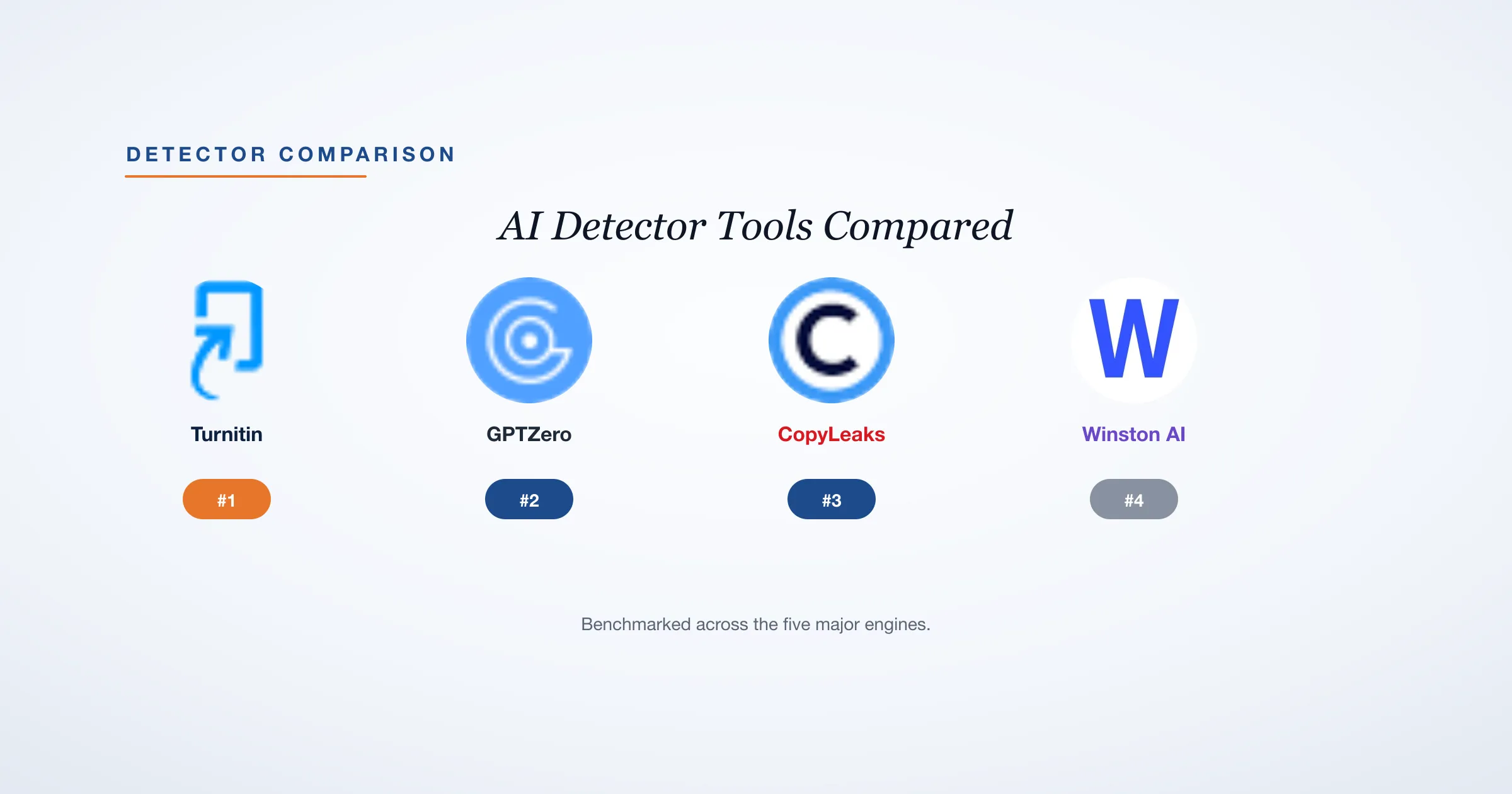
The 2026 five-detector landscape covers Turnitin (institutional, academic-tuned), GPTZero (consumer, web-trained), Winston (claimed 99.98%, content-creator focused), Copyleaks (enterprise + education), and Originality.ai (publishing/content-mill focused). StealthZero’s Proof Reports bundle Turnitin + GPTZero + Winston + CopyLeaks in one PDF.
| Detector | Primary market | Free tier | Cheapest paid | Their accuracy claim |
|---|---|---|---|---|
| GPTZero | Academic + individual | 10,000 words/mo + 3 Advanced Scans | $12.99/mo annual | ”99% Accuracy” (homepage stat) |
| Turnitin | Institutional (universities, K-12, publishers) | None — institutional only | Contact sales | Not publicly stated as a single % |
| Originality.ai | Commercial content / SEO | None (one-time $30 pay-as-you-go) | $12.95/mo annual (Pro) | “Most Accurate” per their own studies |
| Winston AI | Editorial + agencies | 2,000 credits / 14 days | $10/mo annual (Essential) | “99.98% accuracy rate” |
| Copyleaks | Enterprise / editorial | Trial only | $13.99/mo annual (Personal AI-only) | “Over 99% accuracy” (English-only asterisk) |
Weber-Wulff et al. 2023 (Int J Educ Integr 19:26) benchmarked 14 detection tools and found none reached the accuracy needed to be considered reliable in academic integrity workflows — most tools either over-flagged human writing or missed machine-paraphrased AI text.
Sources, all captured 2026-05-28:
The accuracy claims are theirs. None of these numbers has been independently verified by a peer-reviewed comparative study. The closest peer-reviewed result we have is Liang et al. 2023 (Stanford), which found systematic false positive bias in seven detectors against non-native English writing — link in the references at the bottom.
Detector benchmarks and StealthZero coverage
StealthZero runs two in-house detectors (E.D.I.T.H and Sentrio v2) and bundles four third-party detectors into Proof Reports. Sentrio v2 ships four modes and enforces a 100-word minimum. Free tier covers 600 scans per month.
- E.D.I.T.H (Shield-Lite): calibrated to match real-world Turnitin scores, no minimum word count
- Sentrio v2: four modes (Standard, Aggressive, Multilingual, Scholar), 100-word minimum, claims 99%+ accuracy
- Proof Reports: Turnitin + GPTZero + Winston + CopyLeaks (4 detectors per report)
- Pricing: $2.80 single Proof Report, $12.60 5-pack (10% off), $22.40 10-pack (20% off)
- Free tier: 600 scans/month; Pro and Premium: unlimited (fair use)
- Liang et al. 2023 (arXiv:2304.02819) measured false-positive rates above 60% for ESL writers across multiple GPT detectors
What is each AI detector built for?
Each detector is built for a different audience: Turnitin for universities, GPTZero for consumers, Winston for content marketers, Copyleaks for enterprise education, Originality.ai for publishers. Detection scores often disagree across all five on the same text.
GPTZero — academic detection, hybrid statistical-neural
GPTZero was founded in January 2023 (per their homepage footer) and built around perplexity and burstiness scoring. Their public model description states the detector contains “7 components that process text to determine if it was written by AI.”
What they advertise:
- “99% Accuracy” (homepage hero stat)
- “17 million users” (homepage hero — footer paragraph says “over 10 million”)
- “1 million educators” (homepage hero)
- Official AI detector partners of the American Federation of Teachers (per their pricing page footer)
Pricing structure (captured 2026-05-28 from gptzero.me/pricing, “Save 45%” on annual):
| Tier | Annual (per month) | Quota |
|---|---|---|
| Free | $0 | 10,000 words/mo + 3 Advanced Scans |
| Premium | $12.99/mo | 300,000 words/mo |
| Professional | $24.99/mo | 500,000 words/mo |
Best for: students checking their own work, educators evaluating individual submissions, anyone whose evaluator is using GPTZero specifically. Our deeper dive into the pipeline: How GPTZero works.
Turnitin — institutional integrity, bundled with Similarity
Turnitin doesn’t sell to individuals. Per their homepage, they have “more than 16,000 institutions” as customers; the AI detection feature is bundled into existing Feedback Studio and Similarity licenses.
What they advertise (from their homepage):
- “Leading the next chapter of learning integrity”
- “Join more than 16,000 institutions”
- Product line: Feedback Studio, Gradescope, ExamSoft, Similarity, iThenticate, Turnitin Clarity
What they do not publish: a numeric AI detection accuracy claim. Turnitin’s marketing leans on institutional scale and brand age (“since 1998”) rather than a specific percentage.
What this means for students: you cannot buy Turnitin to check your own work. If your school uses it, your evaluator has access to the AI indicator but you don’t. The closest path to a preview is StealthZero’s Turnitin-parity Proof Report, which exports a PDF in the same scoring format your instructor sees — included 1-3/month in paid plans, or $2.80 as a single add-on.
Originality.ai — commercial content focus, patented checker
Originality.ai targets the commercial content / SEO market. Their differentiator on the homepage is a patent (“Patented AI Checker & Content Quality Tools”) and a credit-per-100-words pricing model.
What they advertise (from originality.ai):
- “Accurate AI Detector — For Students & Professionals”
- “Studies Show Originality.ai as the Most Accurate AI Detector” (citing studies they publish themselves)
- “Patented AI Checker”
- Writing Replay (records the writing process as alternative evidence)
Pricing structure (captured 2026-05-28 from originality.ai/pricing, “Save up to 23%” on annual):
| Tier | Annual (per month) | Monthly | Credits |
|---|---|---|---|
| Pay-as-you-go | n/a | $30 one-time | 3,000 credits, expire in 2 years |
| Pro | $12.95/mo (billed $155.40/year) | $14.95/mo | 2,000 credits/mo, 1-month expiry |
| Enterprise | $136.58/mo (billed $1,638.96/year) | $179/mo | 15,000 credits/mo |
Important: 1 credit = 100 words at Originality.ai. AI+Plagiarism combined scans cost 2 credits per 100 words. Don’t compare Originality’s credit counts directly to Copyleaks’ — Copyleaks uses 1 credit = 250 words.
Best for: content agencies verifying freelancer work, publishers with zero-AI policies, SEO teams. Less ideal for ESL writers given the known false-positive issues across strict detectors. Full breakdown: Originality.ai review.
Winston AI — editorial detection with the highest claimed accuracy
Winston AI markets itself as “the only AI detector with a 99,98% accuracy rate” (their European-comma rendering of 99.98%). The number is the highest claimed accuracy in the category. It has not been independently verified outside of Winston’s own benchmarks.
What they advertise (from gowinston.ai):
- “The most trusted AI detector”
- “Trusted by 10M+ users”
- “The only AI detector with a 99,98% accuracy rate”
- Identifies “ChatGPT, Claude, Google Gemini and all known AI models”
Pricing structure (captured 2026-05-28 from gowinston.ai/pricing, “Save 45%” on annual):
| Tier | Annual (per month) | Monthly | Credits/mo |
|---|---|---|---|
| Free | $0 | $0 | 2,000 / 14 days, then expires |
| Essential | $10/mo | $18/mo | 80,000 credits/mo |
| Advanced | $16/mo | $29/mo | 200,000 credits/mo |
| Elite | $26/mo | $49/mo | 500,000 credits/mo |
Winston’s “credit” is roughly equivalent to one word per their usage convention. The free tier is a 14-day trial, not a perpetual free tier — Winston positions detection as a paid product end-to-end. Full review: Winston AI review.
Copyleaks — enterprise editorial integrity
Copyleaks has been in the integrity space since 2015 (per their homepage). They added AI detection on top of their existing plagiarism tooling and now lead with the AI-plus-plagiarism combination.
What they advertise (from copyleaks.com):
- “Content Integrity & AI Detection For Editorial”
- “Over 99% accuracy*, verified through rigorous testing methodologies”
- The asterisk: “Accuracy rating is based on internal testing of the English language datasets.”
- “From Fortune 500 companies to the world’s top universities”
Pricing structure (captured 2026-05-28 from copyleaks.com/pricing):
| Tier | Annual (per month) | Monthly |
|---|---|---|
| Personal — AI Detection only | $13.99/mo | $16.99/mo |
| Personal — AI + Plagiarism | $16.99/mo annual | (variant) |
| Pro — AI Detection only | $74.99/mo | $99.99/mo |
| Pro — AI + Plagiarism | $99.99/mo annual | (variant) |
| Enterprise | Contact sales | — |
1 credit = 250 words OR 1 image. Significantly more words per credit than Originality.ai’s 100/credit. When comparing the two on raw credit count, always normalize to dollars per 10,000 words.
Full head-to-head: Copyleaks vs GPTZero.
How do you pick an AI detector?
Pick by use case: Turnitin-parity proxy for academic submissions, GPTZero free tier for consumer self-checks, Winston for content workflows, Copyleaks for enterprise. For comprehensive checks, StealthZero’s four-detector Proof Report bundles them.
The five-tool landscape is overwhelming because the tools serve different markets. The framework below picks the right one based on what you’re actually trying to do.
”I’m a student and my essay is going through Turnitin”
You can’t access Turnitin directly. Your options:
- Pay for a multi-detector Proof Report that includes a Turnitin-parity score. StealthZero’s report aggregates Turnitin-parity + GPTZero + Winston + CopyLeaks into one PDF. Single is $2.80; the Pro plan ($19.99/mo monthly or $9.99/mo annual) includes 2/month plus unlimited detector scans.
- Cross-check against the next-most-likely detector your instructor would consult. GPTZero is the most-deployed secondary detector in academic settings.
- Skip the detection step entirely and rely on the humanizer — the Cohera sub-model achieves 100% bypass in internal testing.
”I’m an instructor or admin evaluating student work”
Use whatever your institution has licensed. If you have discretion, the trade-off:
- Stricter (more catches, more false positives): Originality.ai
- Balanced (academic-default for two years now): GPTZero
- Fewest false positives at moderate strictness: Winston
Read Is AI detection accurate? before making any high-stakes decision on a single score — the Liang et al. 2023 Stanford study showed systematic bias against non-native English writers across seven major detectors.
”I’m a content team verifying freelancer submissions”
Two candidates:
- Originality.ai Pro ($12.95/mo annual, 2,000 credits/mo) if you trust the stricter classifier and the false positive risk is acceptable for your use case
- Copyleaks Personal — AI + Plagiarism ($16.99/mo annual) if you want both AI and plagiarism in one tool and lower false positive rate
Skip Winston Essential for this use case — its 14-day free trial signals their focus is on enterprise/editorial, not freelancer ops.
”I want one tool that does detection + humanization”
This is StealthZero’s footprint. Free plan includes 600 detector scans + 600 humanizer requests per month. Paid plans (Starter $9.99 / Pro $19.99 / Premium $29.99) add advanced humanizer models (Sentinel, F.R.I.D.A.Y, Jarvis including Cohera) plus monthly Proof Report credits.
The single-tool argument is workflow: humanize and verify in the same product, with one consistent UX and one billing line. The multi-tool argument is “use the actual tool your evaluator uses.”
Both are valid. Match the tool to who’s grading you.
Where does bypass fit in the workflow?
Bypass fits at the rewrite step: humanize after drafting, verify with the relevant detector, then submit — never paste raw AI output. StealthZero’s Cohera model reaches 100% bypass in internal testing across the major detectors.
For posts focused on humanizing AI output rather than detecting it, see the AI humanizer cluster and AI bypass cluster. The short version:
- The Cohera sub-model in StealthZero’s Jarvis tier achieves 100% bypass on internal testing across all four detectors in the Proof Report.
- The base humanizer (Origin, Sentinel-Lite, Sentinel-Max, F.R.I.D.A.Y) targets a 99% pass rate, not a guarantee. Verify before submitting.
Don’t take any single vendor’s bypass claim — including ours — without verifying the output yourself in the detector your evaluator is using.
Pricing-page links (for verification)
All figures in this post were captured on 2026-05-28. Pricing changes; verify before purchase:
- GPTZero: gptzero.me/pricing
- Turnitin: turnitin.com (institutional contact)
- Originality.ai: originality.ai/pricing
- Winston AI: gowinston.ai/pricing
- Copyleaks: copyleaks.com/pricing
- StealthZero: stealthzero.ai/pricing
Related reading
- How AI detection works — pillar post on perplexity, burstiness, and why detectors disagree
- Is AI detection accurate? — the false positive problem
- Copyleaks vs GPTZero — two-tool head-to-head
- Winston AI review
- Originality.ai review
- ZeroGPT review — the free, lighter-weight option (not to be confused with GPTZero)
Sadasivan et al. 2023 (arXiv:2303.11156) showed that even the strongest AI text detectors degrade toward random-chance accuracy under light paraphrasing attacks, suggesting a theoretical ceiling on reliable detection of high-quality AI text.
References
- Liang, W., Yuksekgonul, M., Mao, Y., Wu, E., Zou, J. “GPT detectors are biased against non-native English writers.” Patterns, 4(7), July 2023. Preprint: arXiv:2304.02819.
- All competitor pricing and accuracy claims captured 2026-05-28 from each vendor’s pricing or homepage. Source URLs above.
- Sadasivan, V. S., Kumar, A., Balasubramanian, S., Wang, W., & Feizi, S. (2023). “Can AI-Generated Text Be Reliably Detected?” arXiv:2303.11156. https://arxiv.org/abs/2303.11156
- Weber-Wulff, D., Anohina-Naumeca, A., Bjelobaba, S., et al. (2023). “Testing of detection tools for AI-generated text.” International Journal for Educational Integrity, 19(1). https://doi.org/10.1007/s40979-023-00146-z
Frequently Asked Questions
Which AI detector should I trust for academic work?
If your institution uses Turnitin, that's the detector your work will be evaluated against. Turnitin doesn't sell to students directly — it's institutional. To preview what Turnitin would say before submission, the StealthZero Proof Report runs a Turnitin-parity score plus GPTZero, Winston, and CopyLeaks in one PDF starting at $2.80.
Why do detectors give such different scores for the same paragraph?
Each vendor trains on different AI text, uses a different reference language model for perplexity calculations, and sets a different classifier threshold. The same paragraph that scores 12% on Copyleaks can score 87% on Originality.ai because they are answering slightly different statistical questions.
What's the cheapest legitimate AI detector?
GPTZero Premium at $12.99/mo billed annually is the cheapest paid tier among the major detectors with a real free fallback (10,000 words/mo). Winston Essential is $10/mo billed annually but only 14-day free trial. StealthZero starts at $9.99/mo (Starter) and bundles humanizer access plus detection.
Do these detectors work on Claude and Gemini, or just ChatGPT?
Modern detectors claim coverage across major LLMs. GPTZero, Winston, Copyleaks, and Originality.ai all publicly list ChatGPT (GPT-3.5/4/4o), Claude, Gemini, DeepSeek, and Llama. Accuracy varies by model — newer or less common LLMs tend to evade detection more than older GPT versions.
Is there one detector that catches everything?
No. The detectors disagree by design — different training data, different reference models, different classifier thresholds. The safest workflow is a multi-detector report so you see what every relevant tool would say. StealthZero's Proof Report aggregates four detectors in one PDF.