AI Detection · guides
Humanizer and AI Detector: Why You Need Both Tools (2026)
Using a humanizer without a detector is guesswork. Here is why you need both, how they work together, and which tools offer the humanizer-detector combo in one

A humanizer without a detector is like baking without a thermometer. You might get the result you want, but you will not know until someone else checks. If you are submitting work to a school, client, or journal that runs AI detection, skipping the verification step is guesswork. The humanizer changes the text. The detector tells you whether the change worked. You need both.
This post explains why verification matters, how the two tools work together, and which platforms give you both in one place. For background on how detectors function, read our guide to how AI detection works.
Why does detection verification matter?
Verification matters because rewriting without verifying means submitting blind — the rewrite may have moved the score below threshold, or it may not have. StealthZero’s verifier (E.D.I.T.H + Sentrio v2 with 4 modes) runs in the same window as the humanizer.
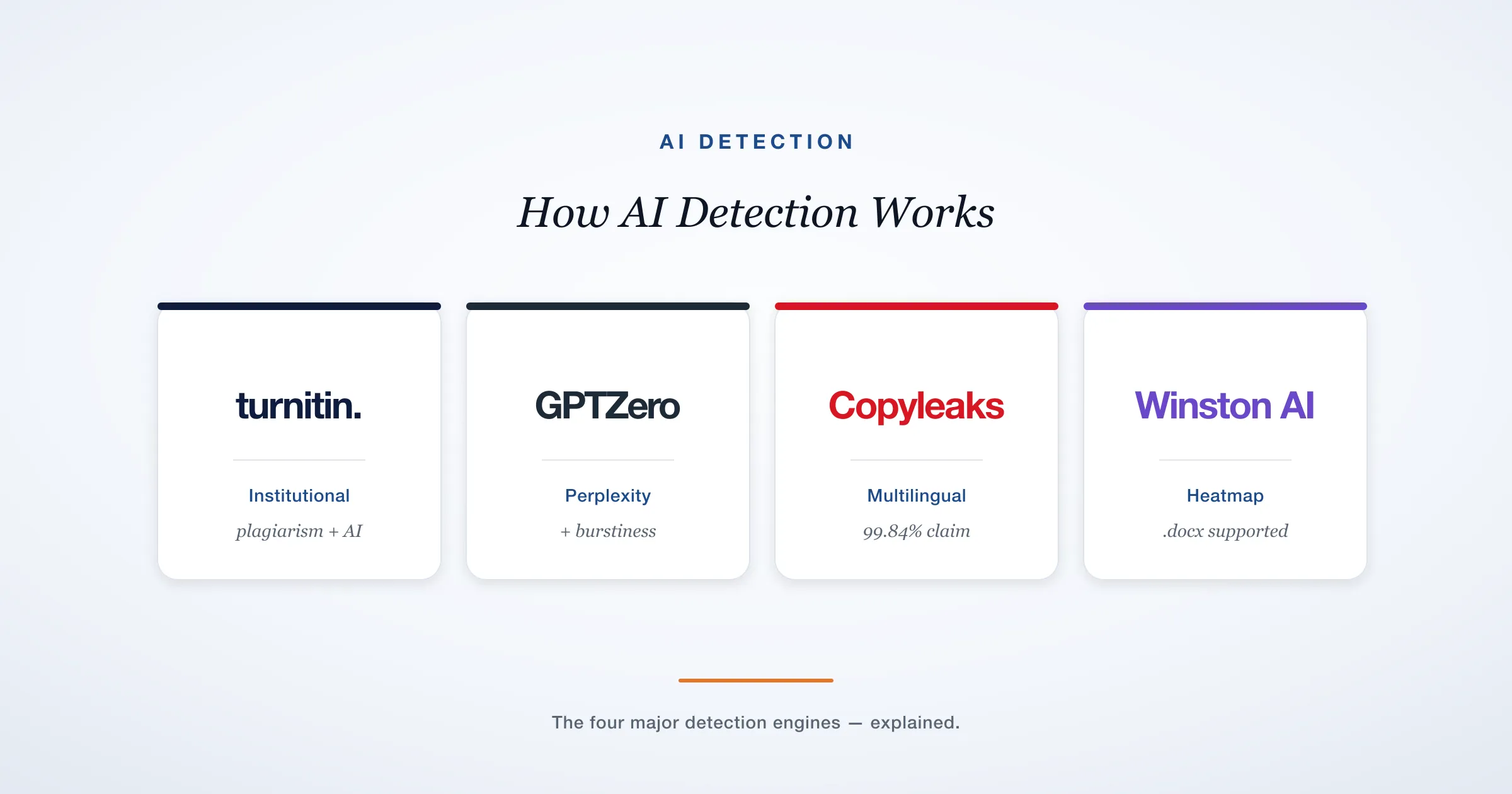
Humanizers rewrite text to disrupt the statistical patterns that detectors score. But detectors update. GPTZero, Turnitin, Winston, and CopyLeaks all retrain their models regularly. A rewrite that passed last month might not pass today. The only way to know for sure is to run the detector on the specific text you plan to submit.
The cost of guessing is high. A student who submits humanized text without verifying might still get flagged, and the conversation with the professor is harder when you cannot show a clean detector score. A content agency that delivers unverified work to a client might face a revision request or a lost contract. A freelancer submitting humanized copy to a platform that runs automatic detection could have their account flagged. The verify step takes under a minute and removes the uncertainty.
The pattern repeats across every use case: the risk is not that the humanizer fails. Most good ones succeed on most text. The risk is that you do not know which time it failed. Verification closes that gap.
Some users assume that a humanizer with a high pass rate makes verification optional. That is a mistake. Even StealthZero’s Cohera model, which reaches 100 percent bypass in internal testing, is tested against current detector versions. When those versions update, the pass rate is re-verified. The tool does the rewrite; the detector confirms the result. Both steps are necessary.
Detector benchmarks and StealthZero coverage
StealthZero runs two in-house detectors (E.D.I.T.H and Sentrio v2) and bundles four third-party detectors into Proof Reports. Sentrio v2 ships four modes and enforces a 100-word minimum. Free tier covers 600 scans per month.
- E.D.I.T.H (Shield-Lite): calibrated to match real-world Turnitin scores, no minimum word count
- Sentrio v2: four modes (Standard, Aggressive, Multilingual, Scholar), 100-word minimum, claims 99%+ accuracy
- Proof Reports: Turnitin + GPTZero + Winston + CopyLeaks (4 detectors per report)
- Pricing: $2.80 single Proof Report, $12.60 5-pack (10% off), $22.40 10-pack (20% off)
- Free tier: 600 scans/month; Pro and Premium: unlimited (fair use)
- Liang et al. 2023 (arXiv:2304.02819) measured false-positive rates above 60% for ESL writers across multiple GPT detectors
Weber-Wulff et al. 2023 (Int J Educ Integr 19:26) benchmarked 14 detection tools and found none reached the accuracy needed to be considered reliable in academic integrity workflows — most tools either over-flagged human writing or missed machine-paraphrased AI text.
How do humanizers and detectors work together?
Humanizers and detectors form a closed loop: the humanizer rewrites toward human statistical patterns; the detector measures whether it succeeded. Without verification, you cannot tell — the prose may look fine and still flag at the sentence level.
The relationship is simple: the humanizer creates a new fingerprint, and the detector checks whether that fingerprint still matches AI patterns.
A humanizer raises perplexity by choosing less predictable word combinations. It raises burstiness by varying sentence length. It swaps vocabulary clusters that detectors associate with AI output. The output should read naturally and score as human on detection.
The detector then scores the rewritten text on the same signals. If the perplexity and burstiness are high enough, and the vocabulary clusters no longer match AI training data, the detector returns a human verdict. If something in the rewrite still matches an AI pattern, the detector flags it.
This is why the two tools are complementary, not interchangeable. A humanizer without a detector is a black box. A detector without a humanizer only tells you what you already know — that the text is AI-generated. Together they form a closed loop: write, humanize, verify, submit.
For a comparison of the major detector tools, see AI detector tools compared.
How does StealthZero combine humanizer and detector?
StealthZero ships humanizer (Origin / Sentinel / F.R.I.D.A.Y / Cohera) and detector (E.D.I.T.H + Sentrio v2 with Standard / Aggressive / Multilingual / Scholar modes) in one interface, plus four-detector Proof Reports (Turnitin + GPTZero + Winston + CopyLeaks).
StealthZero bundles both tools so you never have to switch sites or paste text twice.
The humanizer side offers five models: Origin, Sentinel-Lite, Sentinel-Max, F.R.I.D.A.Y, and Jarvis (with Homer, Cohera, and Max sub-models). Cohera reaches 100 percent bypass in internal testing and is tuned for academic work. Origin is free and unlimited.
The detector side offers two engines:
- E.D.I.T.H: no minimum word count, fast results, good for short passages and quick checks.
- Sentrio v2: minimum 100 words, four modes (Standard, Aggressive, Multilingual, Scholar). The Scholar mode is designed for academic writing and checks against the same signals Turnitin uses.
After humanizing, you can paste the output directly into either detector without leaving the platform. If the text passes, you are done. If it fails on one detector, you know exactly which engine to address. Then you can re-humanize or manually edit the flagged section.
The platform also generates Proof Reports — PDF exports that bundle scores from Turnitin, GPTZero, Winston, and CopyLeaks into one document. For high-stakes submissions, the Proof Report is the verification step you can hand to a reviewer.
What other tools combine humanizer and detector?
Undetectable AI also bundles a humanizer and a detector. It starts at $5/month annual for 10,000 words. The vendor claims “99 percent-plus Accuracy” (captured 2026-05-28). The downside is the word quota and the lack of Proof Reports. You can verify your text, but you cannot export a multi-detector PDF for your records.
HIX Bypass, Humbot, StealthGPT, and QuillBot do not include a bundled detector. If you use one of these tools, you need to buy a separate detector subscription or use a free detector tool and paste the output manually. That adds cost and friction to the workflow.
The cost adds up fast. GPTZero starts at $12.99/month annual (captured 2026-05-28). Winston AI starts at $10/month annual and claims 99.98 percent accuracy. If you are paying $9.99/month for HIX Bypass and $12.99/month for GPTZero separately, you are spending $23/month for what StealthZero and Undetectable AI bundle into one subscription.
If you want to learn more about how specific detectors score text, read our guide to what an AI humanizer is and how humanizers interact with each detector.
For a deep dive into how GPTZero specifically scores text, see our post on how GPTZero works.
What is the humanize-then-verify workflow?
Humanize-then-verify: paste your draft, lock citations and key terms, rewrite with the appropriate model (Cohera for Turnitin), verify with Sentrio v2 (100-word minimum, 4 modes), and export a Proof Report if you need documentation.
Here is the exact loop we recommend:
- Humanize. Paste your AI-generated text into StealthZero’s humanizer. Pick a model and tone. Lock citations and key terms. Run the rewrite.
- Detect. Copy the output and paste it into E.D.I.T.H for a quick check, or Sentrio v2 Scholar mode for academic work. Wait for the score.
- Fix. If the detector flags the text, identify the flagged section. Re-humanize that section with a stronger model, or manually edit the sentences that still sound too predictable.
- Report. For submissions where the detector verdict matters, generate a Proof Report. Save the PDF alongside your document.

The full loop takes under a minute once you know the steps. The alternative is submitting without verifying, which is guessing.
If you want to test the workflow for free, StealthZero’s free tier includes 600 requests per month with no word cap per request and limited detector scans. See humanize AI text for free for the details.
FAQ
Do I need a detector if I use a humanizer?
Yes. A humanizer rewrites text, but without running a detector on the output, you do not know if it actually passed. The verify step is what separates a smart workflow from guessing. StealthZero includes both tools in one platform.
Can an AI detector detect humanized text?
It depends on the humanizer quality and the detector version. Good humanizers like StealthZero’s Cohera model (100% bypass in internal testing) regularly pass. But detectors update, so the only way to know for sure is to run the detector on the specific output.
Which tools combine a humanizer and detector?
StealthZero includes both a humanizer and two detector engines (E.D.I.T.H and Sentrio v2) in one platform. Undetectable AI also bundles both. Most standalone humanizers (HIX Bypass, Humbot) do not include a detector.
What is the humanize-then-verify workflow?
Step one: paste AI text into the humanizer and run the rewrite. Step two: run the detector on the output to see if it passes. Step three: if it fails, re-humanize or manually adjust. Step four: for high-stakes work, export a Proof Report. This loop takes under a minute.
Getting started
Start with StealthZero’s humanizer and detector. Run the full loop on a sample paragraph. Once you see how the two tools talk to each other, apply the workflow to your real documents. If you need more advanced model requests or unlimited detector scans, check the pricing page.
Sadasivan et al. 2023 (arXiv:2303.11156) showed that even the strongest AI text detectors degrade toward random-chance accuracy under light paraphrasing attacks, suggesting a theoretical ceiling on reliable detection of high-quality AI text.
References
- Liang, W., Yuksekgonul, M., Mao, Y., Wu, E., & Zou, J. (2023). “GPT detectors are biased against non-native English writers.” arXiv:2304.02819 — https://arxiv.org/abs/2304.02819
- Sadasivan, V. S., Kumar, A., Balasubramanian, S., Wang, W., & Feizi, S. (2023). “Can AI-Generated Text Be Reliably Detected?” arXiv:2303.11156. https://arxiv.org/abs/2303.11156
- Weber-Wulff, D., Anohina-Naumeca, A., Bjelobaba, S., et al. (2023). “Testing of detection tools for AI-generated text.” International Journal for Educational Integrity, 19(1). https://doi.org/10.1007/s40979-023-00146-z
Frequently Asked Questions
Do I need a detector if I use a humanizer?
Yes. A humanizer rewrites text, but without running a detector on the output, you do not know if it actually passed. The verify step is what separates a smart workflow from guessing. StealthZero includes both tools in one platform.
Can an AI detector detect humanized text?
It depends on the humanizer quality and the detector version. Good humanizers like StealthZero's Cohera model (100% bypass in [internal testing](/blog/ai-humanizer/our-methodology-1000-essays/)) regularly pass. But detectors update, so the only way to know for sure is to run the detector on the specific output.
Which tools combine a humanizer and detector?
StealthZero includes both a humanizer and two detector engines (E.D.I.T.H and Sentrio v2) in one platform. Undetectable AI also bundles both. Most standalone humanizers (HIX Bypass, Humbot) do not include a detector.
What is the humanize-then-verify workflow?
Step one: paste AI text into the humanizer and run the rewrite. Step two: run the detector on the output to see if it passes. Step three: if it fails, re-humanize or manually adjust. Step four: for high-stakes work, export a Proof Report. This loop takes under a minute.