AI Rephraser · guides
Humanizer vs Paraphrase Tool (2026): Which Do You Need?
Paraphrasers reword text for clarity. Humanizers change AI detection scores. Here is the technical difference and when to use each tool.

People search “humanizer paraphrase” every day because the two terms get mixed together constantly. Blog posts, product pages, and Reddit threads all treat them like synonyms. They are not. A paraphraser and a humanizer both reword text, but they target completely different signals, solve different problems, and produce output that behaves differently when run through automated checks.
Sadasivan et al. 2023 (arXiv:2303.11156) showed that even the strongest AI text detectors degrade toward random-chance accuracy under light paraphrasing attacks, suggesting a theoretical ceiling on reliable detection of high-quality AI text.
This post explains the technical difference, when each tool is the right choice, and what happens when you pick the wrong one.
What does a paraphraser actually do?
A paraphraser targets the similarity score by swapping synonyms, reordering clauses, shifting voice, and condensing phrases. It does not change the perplexity/burstiness profile that AI detectors measure — Liang et al. (2023, arXiv:2304.02819) explain why those signals are model-fingerprint-based, not vocabulary-based.
A paraphraser takes input text and produces a new version with different wording but the same meaning. The core operations are:
- Synonym substitution: “significant” becomes “notable” or “considerable”
- Clause reordering: moving dependent clauses before or after the main clause
- Voice shifting: active to passive, or the reverse
- Condensation: collapsing verbose phrases into tighter wording
The goal is readability improvement and text-similarity reduction. Paraphrasers are built to help you avoid matching existing sources on plagiarism checkers. They target the similarity score, not the AI score.
QuillBot is the best-known example. Its free tier paraphrases up to 125 words at a time in two modes (Standard and Fluency). Premium gives access to eight or more modes and removes the word cap. At $8.33/month billed annually, it calls itself “The only AI subscription you’ll ever need.” For clarity and plagiarism-related rewriting, that claim is defensible. QuillBot is good at what it does.
But “what it does” is reword for readability. It was not designed to fool AI detectors because when QuillBot launched, AI detectors did not exist yet.
Rephraser quotas and pricing at a glance
Free tier covers 600 rephrase requests per month with a 20-per-day cap and unlimited words per request. Pro covers 3,000 advanced model requests at $19.99/month. Auto Agent Rephrase batches up to 12,000 words per task.
- Free plan: 600 requests/month, 20/day cap, unlimited Origin model
- Starter ($9.99/mo): unlimited Origin + 1,500 advanced requests (50/day cap)
- Pro ($19.99/mo): 3,000 advanced requests (100/day cap), 80+ languages, API access
- Premium ($29.99/mo): unlimited all models, 100+ languages, 5 Auto Agent credits
- Auto Agent Rephrase add-ons: Mini $3.99 (2,000 words), Pro $6.99 (5,000 words), Max $12.99 (12,000 words)
- Liang et al. 2023 (arXiv:2304.02819) documented over 60% false-positive rates for ESL writers across mainstream GPT detectors
Weber-Wulff et al. 2023 (Int J Educ Integr 19:26) benchmarked 14 detection tools and found none reached the accuracy needed to be considered reliable in academic integrity workflows — most tools either over-flagged human writing or missed machine-paraphrased AI text.
What does a humanizer do differently?
A humanizer rewrites the statistical fingerprint — perplexity, burstiness, stylometric features — that AI detectors measure. StealthZero ships five models for this (Origin, Sentinel-Lite/Max, F.R.I.D.A.Y, Jarvis with Cohera sub-model at 100% bypass in internal testing) plus two detector engines for verification.
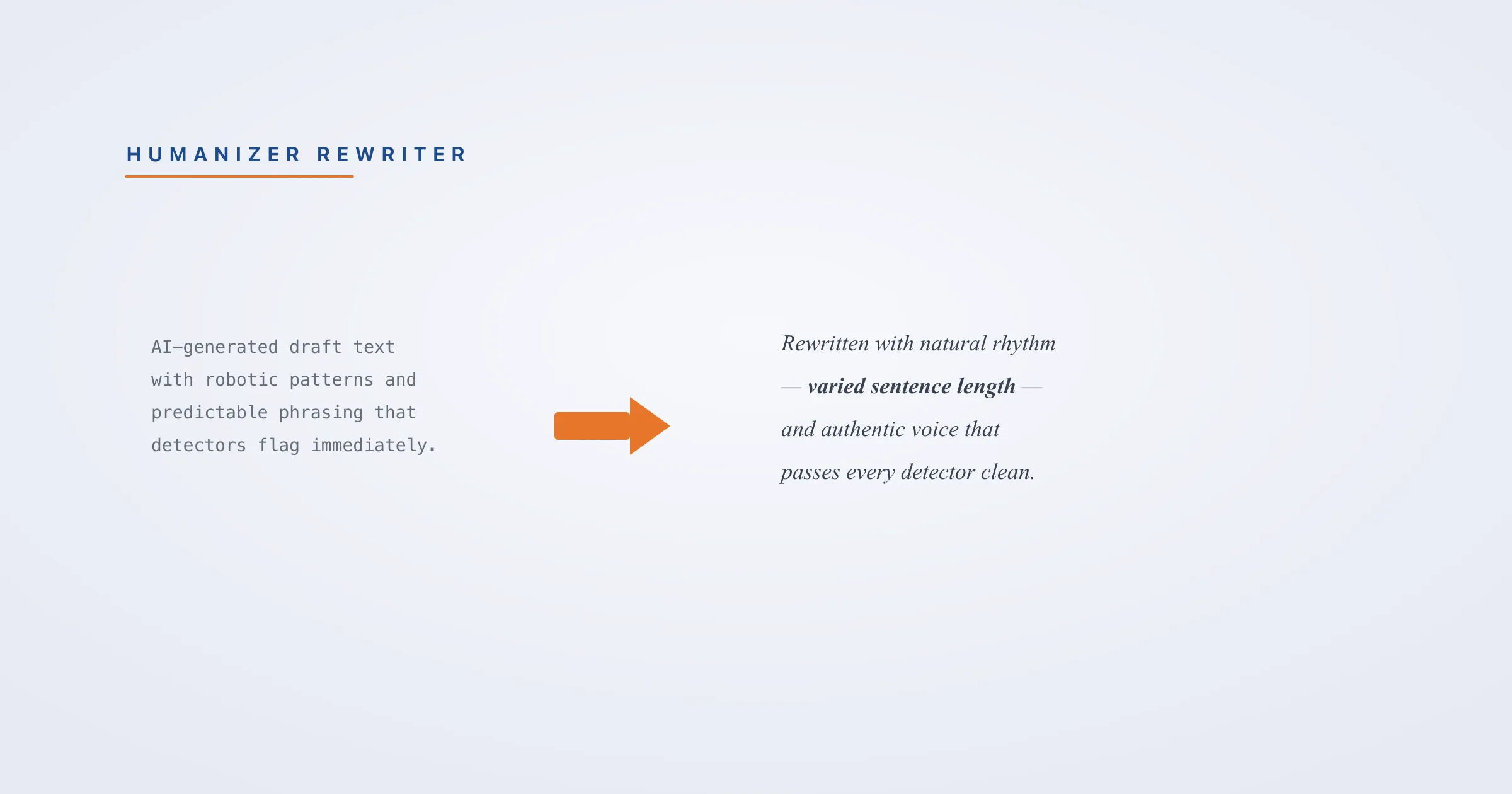
A humanizer also rewords text, but the optimization target is entirely different. Instead of changing which words appear, a humanizer changes the statistical fingerprint of the writing. AI detectors do not scan for specific words. They measure patterns:
- Perplexity: how predictable each word is given the surrounding context. AI text has low perplexity because language models pick statistically likely next tokens. Human writing is less predictable.
- Burstiness: how much sentence length and complexity vary across the document. AI text is uniform. Human writing mixes short punchy sentences with longer ones.
- Stylometric features: rhythm, transition patterns, punctuation habits, paragraph structure. AI models develop characteristic habits that detectors learn to recognize.
A humanizer breaks apart sentences, varies their lengths, introduces less-predictable word choices, and restructures passages so these statistical measurements shift toward what a human writer would produce. The output often reads differently from the input in ways that go beyond synonym swaps.
If you want a deeper explanation of what humanizers are and how they work, see what is an AI humanizer.
How do paraphrasers and humanizers compare technically?
| Feature | Paraphraser | Humanizer |
|---|---|---|
| Primary target | Plagiarism / similarity score | AI detection score |
| What changes | Words, phrases, clause order | Perplexity, burstiness, sentence rhythm, stylometric patterns |
| What detectors see | Different words, same pattern signature | Different pattern signature |
| Handles similarity checks | Yes, this is the design goal | Sometimes, as a side effect |
| Handles AI detection | Unreliably, not designed for this | Yes, this is the design goal |
| Output readability | High, that is the optimization target | Varies; some models sacrifice smoothness for pattern change |
| Typical use case | Rewriting source material, clarifying drafts | Preparing AI-assisted text for detector screening |
| Example tool | QuillBot paraphraser | StealthZero Rephrase |
The key distinction is in the second row. A paraphraser changes what the text says and how it reads. A humanizer changes how the text behaves statistically. Those are different problems, and a tool built for one is not automatically good at the other.
Where they overlap
Both tools produce rewritten text. Both change words. Both can improve readability. That surface-level similarity is why the confusion exists.
The overlap gets real when you look at output. A strong humanizer often produces text that is also sufficiently different from sources to pass plagiarism checks, because rewriting at the pattern level involves enough word changes to drop similarity scores. And a paraphraser can sometimes nudge an AI detection score down a few points because any rewriting introduces some variation.
But “sometimes” and “a few points” are not reliable. If your text is going through Turnitin AI detection, GPTZero, or Winston AI, a paraphraser is the wrong tool for the job. The detector will still see the underlying pattern signature even after synonyms are swapped.
When should you use a paraphraser?
Paraphrasers are the right choice in several legitimate scenarios:
Rewriting source material for integration. You read a journal article, you want to incorporate the finding in your own words, you paste the relevant passage into a paraphraser, and you get a version that will not trigger a similarity match. This is what QuillBot’s Standard and Fluency modes are built for.
Improving clarity. You wrote something dense or awkward and you want a cleaner version without rewriting from scratch. A paraphraser gives you options quickly.
Simplifying complex text. You have technical or jargon-heavy content and you need a version that a general audience can follow.
Reducing text similarity. Your draft has a high similarity score on Turnitin or another plagiarism checker, and you need to bring that number down before submission.
In all of these cases, AI detection is not part of the equation. If nobody is running your text through an AI detector, a paraphraser does exactly what you need. There is no reason to use a humanizer for a clarity problem.
When should you use a humanizer?
Reach for a humanizer when your text will face AI detection screening:
You used AI assistance to draft. You wrote a paper or article with help from ChatGPT, Claude, or another language model, and your school or publisher runs AI detection on submissions. A paraphraser will not reliably change the detection verdict. A humanizer is built for this.
You are submitting through Turnitin. Turnitin now runs both similarity checking and AI detection. If your text has AI-generated content, the AI report will flag it regardless of what the similarity report says. See our breakdown of whether Turnitin detects ChatGPT for specifics.
You want to verify before submitting. Tools like the StealthZero detector give you a sentence-level breakdown of how your text scores before you submit. If the score is high, the StealthZero rephrase tool can address it. Proof Reports run your text through Turnitin, GPTZero, Winston, and CopyLeaks so you see the same numbers your reviewer will see.
You are publishing on a platform that screens for AI. Some publishers and content platforms now check incoming submissions for AI-generated content. A humanizer addresses the specific signals those screeners measure.
For a broader look at the top options, see the best AI humanizers in 2026.
What is the right combined workflow?
Humanize first, then paraphrase for clarity, then verify. StealthZero’s Auto Agent Rephrase add-on batches up to 12,000 words per task for long documents; the Pro tier ships 2 Proof Reports and 3,000 advanced model requests per month for sustained academic-volume work.
If you have AI-generated text that also needs clarity work, the most effective workflow runs both tools in sequence:
-
Run the humanizer first. Pass your AI-generated draft through a humanizer to address the statistical patterns detectors score. This is the step that actually changes whether your text passes detection. StealthZero’s models (Origin on the free plan, Sentinel and higher on paid plans) are designed for this.
-
Edit or paraphrase for readability. Humanized text sometimes reads slightly differently from what you want. Run it through a paraphraser, or manually edit for flow, clarity, and tone. This step does not re-introduce AI patterns because you are making targeted edits, not regenerating the text through a language model.
-
Verify before submitting. Run the final version through a detector to confirm the AI score is where you need it. If it is, submit. If not, re-humanize the flagged sections.
This order matters. If you paraphrase first and then humanize, you waste the paraphrase step because the humanizer will rewrite everything anyway. Humanize first to solve the detection problem, then refine for readability.
StealthZero’s Rephrase tool supports locked phrases, so you can protect citations, technical terms, and proper nouns while the humanizer rewrites everything else. This prevents the common problem of a rewriter mangling a citation like (Chen et al., 2025, p. 47) into something unusable.
QuillBot specifically: they offer both
QuillBot is an interesting case study because they now offer a paraphraser and a humanizer as separate tools within the same product. This is the clearest real-world proof that the two categories solve different problems.
QuillBot Paraphraser (free tier): 125 words per paraphrase, two modes. Designed for clarity and text-similarity reduction. This is the tool QuillBot built its reputation on.
QuillBot Humanizer (free tier): 125 words per use, 6 uses per day. Designed for AI detection bypass. This is a newer addition that exists specifically because the paraphraser does not solve the detection problem on its own.
QuillBot Premium ($8.33/month, annual billing): Removes the word cap on both tools. The paraphraser gets access to eight or more modes. The humanizer becomes unlimited.
The fact that QuillBot ships these as two distinct tools tells you everything you need to know. If a paraphraser could reliably beat AI detection, QuillBot would not have needed to build a separate humanizer. They did, because the problems are different.
For a direct comparison of how StealthZero stacks up against QuillBot’s paraphraser specifically, see StealthZero vs QuillBot.
StealthZero pricing reference
For context on where StealthZero fits:
| Plan | Price | What you get |
|---|---|---|
| Free | $0 | Origin model, 600 requests/month, 20/day, unlimited words per request |
| Starter | $9.99/month | Sentinel model, higher pass rates against stricter detectors |
| Pro | $19.99/month | F.R.I.D.A.Y model, stronger rewriting for tougher detection |
| Premium | $29.99/month | Jarvis and Cohera models; the Cohera model achieves 100% bypass in StealthZero’s internal testing |
The base humanizer flow targets a 99% pass rate across detectors. Proof Reports are available on paid plans so you can verify the output against the same tools your institution uses. Full pricing details are on the StealthZero pricing page.
For a free option that addresses detection specifically, see how to humanize AI text for free.
Bottom line
The humanizer paraphrase distinction comes down to this: paraphrasers change words, humanizers change patterns. AI detectors measure patterns, not words. Plagiarism checkers measure word overlap, not patterns.
Use a paraphraser when you need clarity, simplification, or similarity-score reduction. Use a humanizer when you need to pass AI detection. Use both in sequence when you need to handle both problems on the same text.
The tools are not interchangeable. Picking the right one for your actual problem saves time and avoids the frustrating experience of running a paraphraser on AI-generated text, checking it on GPTZero, and watching it still get flagged.
For more on AI detection mechanics, see how AI detection works. For the Turnitin-specific pipeline, see how to pass Turnitin AI detection.
References
- Liang, W., Yuksekgonul, M., Mao, Y., Wu, E., & Zou, J. (2023). “GPT detectors are biased against non-native English writers.” arXiv:2304.02819. https://arxiv.org/abs/2304.02819
- Sadasivan, V. S., Kumar, A., Balasubramanian, S., Wang, W., & Feizi, S. (2023). “Can AI-Generated Text Be Reliably Detected?” arXiv:2303.11156. https://arxiv.org/abs/2303.11156
- Weber-Wulff, D., Anohina-Naumeca, A., Bjelobaba, S., et al. (2023). “Testing of detection tools for AI-generated text.” International Journal for Educational Integrity, 19(1). https://doi.org/10.1007/s40979-023-00146-z
Updated 2026-05-28.
Frequently Asked Questions
Is a humanizer the same as a paraphraser?
No. A paraphraser rewords text by swapping synonyms and reordering clauses to improve clarity or avoid plagiarism matches. A humanizer is specifically built to change the statistical patterns — perplexity, burstiness, sentence rhythm — that AI detectors use to flag machine-written content. They solve different problems.
Can I use a paraphraser to pass AI detection?
Sometimes, but not reliably. Paraphrasers change surface-level wording without addressing the underlying statistical patterns detectors measure. A paraphraser might lower your AI score slightly, but it rarely changes the verdict on a strict detector. A humanizer is purpose-built for this.
When should I use a paraphraser instead of a humanizer?
Use a paraphraser when you need to reword for clarity, simplify complex language, or avoid plagiarism matches on a similarity checker. Use a humanizer when your primary goal is passing an AI detector like Turnitin, GPTZero, or Winston.
Does QuillBot's paraphraser also humanize?
QuillBot offers both a paraphraser and a separate AI humanizer tool. The paraphraser (free at 125 words) rewords for clarity and style. The humanizer (free at 125 words, 6 uses/day) is designed for AI detection bypass. They are different tools within the same product.
Which should I use first — a paraphraser or a humanizer?
If you are starting with AI-generated text, run the humanizer first to address detector signals, then use a paraphraser (or manual editing) to fine-tune clarity and flow. The humanizer handles the detection problem; the paraphraser handles the readability problem.