AI Rephraser · guides
Humanizer Paraphraser (2026)
Humanizer vs paraphraser: what is the difference, which tools combine both, and when should you use each? A practical 2026 guide.

People search “humanizer paraphraser” because they are not sure which tool they need. The two functions overlap but solve different problems. A paraphraser rewords text for clarity and originality. A humanizer rewrites text specifically to evade AI detection. Some tools do one, some do the other, and a few try to do both. Understanding the difference saves you from buying the wrong product or running your text through a tool that cannot solve your actual problem.
Sadasivan et al. 2023 (arXiv:2303.11156) showed that even the strongest AI text detectors degrade toward random-chance accuracy under light paraphrasing attacks, suggesting a theoretical ceiling on reliable detection of high-quality AI text.
This post explains the difference between a humanizer and a paraphraser, why the combined search term exists, which tools combine both functions, how StealthZero compares to QuillBot (the best-known combined tool), and when to use each approach. Pricing was captured from public pricing pages on 2026-05-28.
What is the difference between a humanizer and a paraphraser?
The core distinction is the target. Paraphrasers swap synonyms to lower text similarity; humanizers rewrite statistical patterns (perplexity, burstiness, vocabulary clusters) to lower an AI detection score. Liang et al. (2023, arXiv:2304.02819) document the underlying signals detectors actually scan.
The core distinction is the target, not the mechanism.
What a paraphraser does
A paraphraser takes text and produces an alternative version with the same meaning but different words and sentence structures. The goal is clarity, originality, or simplification. Paraphrasers are used to:
- Avoid text-similarity matches against indexed sources
- Simplify complex writing for a broader audience
- Generate alternative phrasings for A/B testing
- Repurpose content across platforms
A paraphraser does not care about AI detection. It may incidentally change some AI signals, but that is a side effect, not the design goal.
What a humanizer does
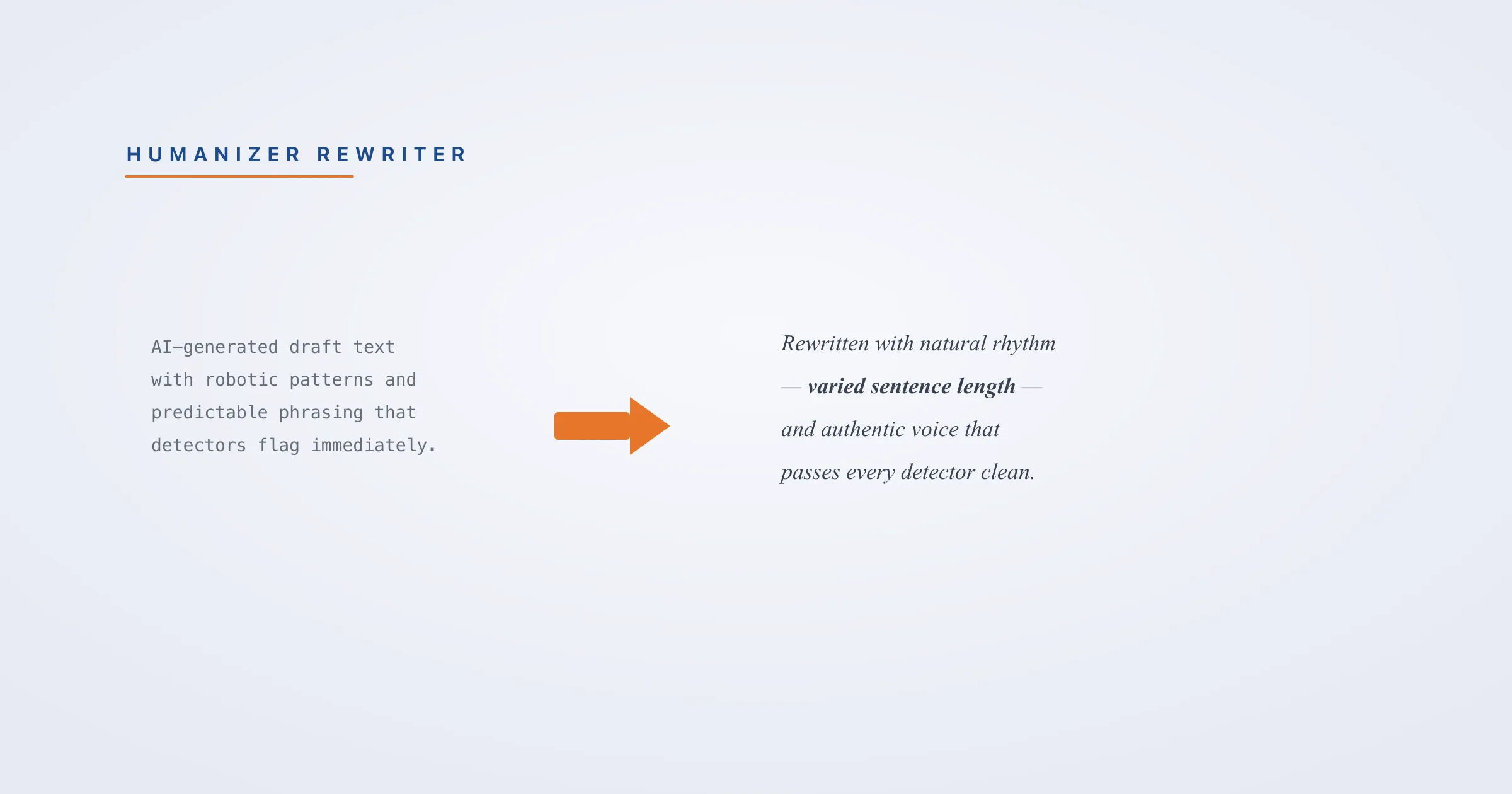
A humanizer takes AI-generated text and rewrites it so AI detectors score it as human-written. The goal is to break the statistical patterns that detectors measure:
- Perplexity — variation in word choice and predictability
- Burstiness — variation in sentence length
- Vocabulary clusters — overused phrases common in AI output
A humanizer may paraphrase as part of its work, but its success metric is detection evasion, not textual originality.
The overlap
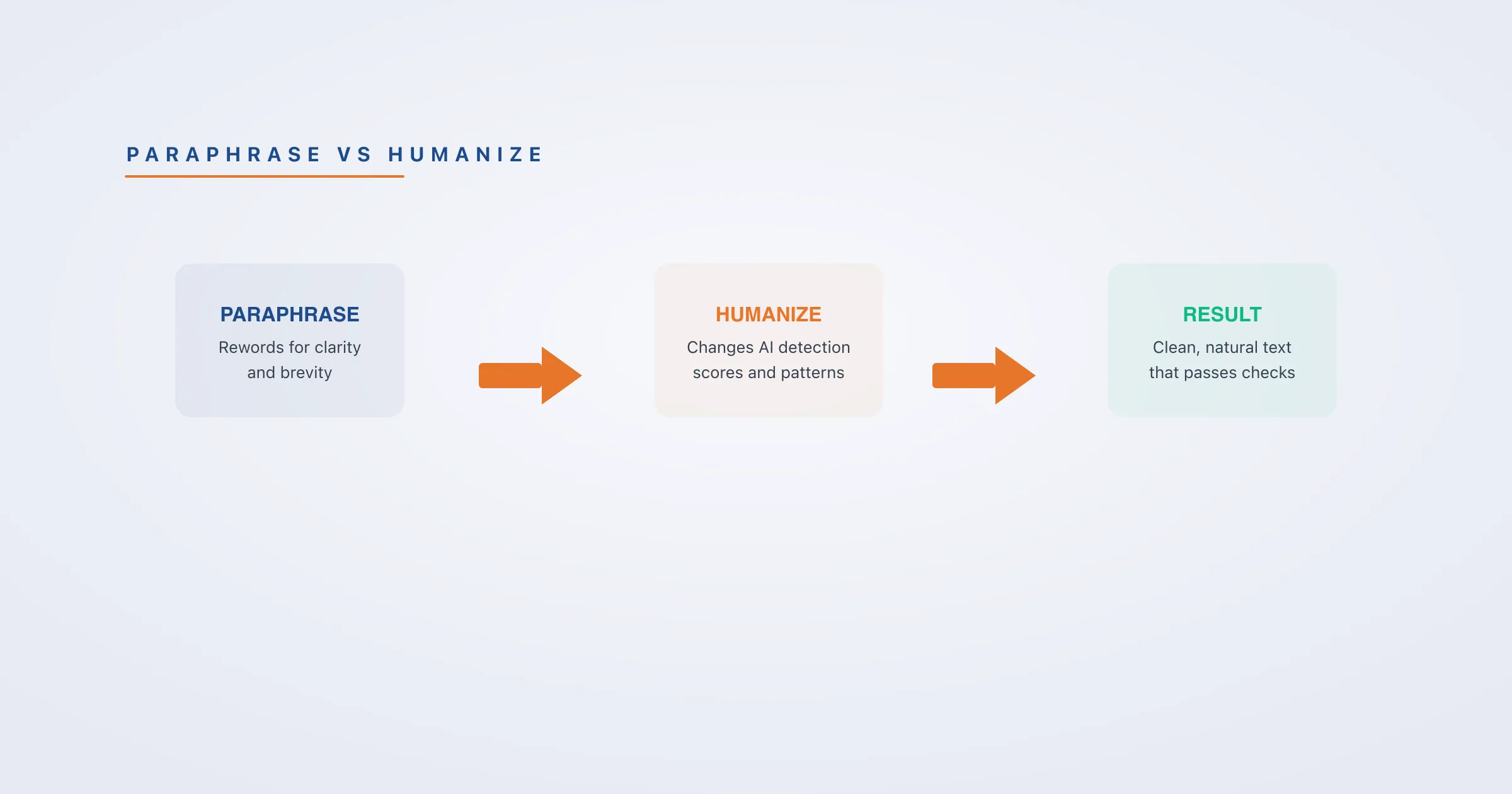
Both tools rewrite text. Both change words and sentences. The difference is what they optimize for. A paraphraser optimizes for meaning preservation and readability. A humanizer optimizes for detector evasion while keeping meaning intact.
| Aspect | Paraphraser | Humanizer |
|---|---|---|
| Primary goal | Reword for clarity/originality | Evade AI detection |
| Target input | Any text | AI-generated text |
| Success metric | Readable, original output | Passes detector scores |
| Detector awareness | None | Built into good tools |
| Meaning priority | High | High |
| Tone control | Sometimes | Usually |
Rephraser quotas and pricing at a glance
Free tier covers 600 rephrase requests per month with a 20-per-day cap and unlimited words per request. Pro covers 3,000 advanced model requests at $19.99/month. Auto Agent Rephrase batches up to 12,000 words per task.
- Free plan: 600 requests/month, 20/day cap, unlimited Origin model
- Starter ($9.99/mo): unlimited Origin + 1,500 advanced requests (50/day cap)
- Pro ($19.99/mo): 3,000 advanced requests (100/day cap), 80+ languages, API access
- Premium ($29.99/mo): unlimited all models, 100+ languages, 5 Auto Agent credits
- Auto Agent Rephrase add-ons: Mini $3.99 (2,000 words), Pro $6.99 (5,000 words), Max $12.99 (12,000 words)
- Liang et al. 2023 (arXiv:2304.02819) documented over 60% false-positive rates for ESL writers across mainstream GPT detectors
Weber-Wulff et al. 2023 (Int J Educ Integr 19:26) benchmarked 14 detection tools and found none reached the accuracy needed to be considered reliable in academic integrity workflows — most tools either over-flagged human writing or missed machine-paraphrased AI text.
Why do people search “humanizer paraphraser”?
The combined search term exists for three reasons.
1. The tools are marketed together
QuillBot, the largest player in this space, bundles a paraphraser and a humanizer in the same product. Users see both features in one interface and assume they are the same thing. They are not.
2. The use cases overlap
A student who paraphrases a source to avoid similarity matches may also need to humanize an AI-generated section of the same paper. One document, two problems, one search query.
3. The vocabulary is fuzzy
“Paraphrase,” “rephrase,” “rewrite,” and “humanize” are used interchangeably in casual speech. Search engines get ambiguous queries because users themselves are not sure what they need.
If you are unsure which tool you need, ask yourself: is the problem a detector flagging my text as AI, or is the problem that my text is too similar to a source? If it is the detector, you need a humanizer. If it is similarity, you need a paraphraser.
Which tools combine both functions?
Four tools cover the combined space: QuillBot (paraphrase-first suite with humanizer add-on, $8.33/mo annual), StealthZero (humanizer-first with five models, Cohera at 100% bypass in internal testing), Humbot (study suite, $7.99/mo annual), and HIX Bypass (single-mode humanizer, $9.99/mo annual). Only StealthZero ships a multi-detector Proof Report (Turnitin + GPTZero + Winston + CopyLeaks — 4 detectors).
Several tools now offer both paraphrasing and humanization in one product.
QuillBot
QuillBot Premium includes:
- Paraphraser with 8+ modes (Standard, Fluency, Formal, Simple, Creative, Shorten, Expand, custom)
- Grammar checker
- AI humanizer (unlimited words on Premium; 125 words / 6 uses per day on Free)
- AI detector
- Plagiarism checker
- Summarizer, citation generator, translator, AI chat, AI image generator
QuillBot does not publish a numeric bypass rate or accuracy claim for its humanizer. The humanizer is a feature inside a larger suite, not the headline product.
StealthZero
StealthZero includes:
- AI humanizer with 5 rewrite models (Origin, Sentinel-Lite, Sentinel-Max, F.R.I.D.A.Y, Jarvis with Homer, Cohera, Max)
- AI detector with two engines (E.D.I.T.H and Sentrio v2, 4 modes)
- Multi-detector Proof Reports (Turnitin + GPTZero + Winston + CopyLeaks)
- Per-sentence rephrase control
- Locked phrases and protected keywords
StealthZero does not market itself as a paraphraser, though the Origin model can perform paraphrasing-style rewrites. The product is specialized for detection evasion, not general rewriting.
Humbot
Humbot offers basic and advanced humanization modes. The tool positions itself as a study suite rather than a pure humanizer. Pricing: Basic $7.99/mo annual (3,000 basic + 1,000 advanced words), Pro $9.99/mo annual (30,000 + 5,000 words).
HIX Bypass
HIX Bypass markets humanization with a single rewrite mode. Standard plan is $9.99/mo annual with 5,000 words. No paraphrasing-specific features are advertised.
StealthZero vs QuillBot comparison
Since QuillBot is the tool most users compare against, here is a direct feature and pricing breakdown.
Pricing (captured 2026-05-28)
| Plan | QuillBot | StealthZero |
|---|---|---|
| Free | $0 — 125 words/paraphrase, 2 modes, humanize 125 words / 6 uses/day, limited detector | $0 — 600 req/mo, 20/day, unlimited words/req on Origin, full detector |
| Cheapest paid (annual) | Premium $8.33/mo | Starter $7.99/mo |
| Mid-tier paid (annual) | Premium only paid tier for individuals | Pro $9.99/mo |
| Top tier (annual) | Team plan (contact sales) | Premium $23.99/mo |
Paraphrasing capability
| Feature | QuillBot Premium | StealthZero |
|---|---|---|
| Paraphrase modes | 8+ (Standard, Fluency, Formal, Simple, Creative, Shorten, Expand, custom) | Not a primary feature; Origin does general rewrites |
| Word limit per use | Unlimited on Premium | Unlimited words per request on Origin |
| Synonym control | Slider | Not applicable |
| Grammar integration | Built-in | Separate concern |
QuillBot is the stronger paraphraser by design. It is built for clarity and originality, not detection evasion.
Humanizing capability
| Feature | QuillBot Premium | StealthZero |
|---|---|---|
| Humanizer models | 1 | 5 + 3 sub-models |
| Published bypass rate | None published | 99% target standard flow; 100% Cohera in internal testing |
| Detector built-in | Yes (single mode) | E.D.I.T.H + Sentrio v2 (4 modes) |
| Multi-detector report | No | Yes (PDF with Turnitin + GPTZero + Winston + CopyLeaks) |
| Locked phrases | Partial (quoted text) | Yes (first-class UI control) |
| Tone control | Within modes | 6+ tones depending on model |
StealthZero is the stronger humanizer by design. The multiple models, detection verification, and Proof Reports exist specifically for high-stakes detection scenarios.
When to choose which
- Choose QuillBot if your primary need is paraphrasing for clarity, reducing text similarity, or generating citation-ready writing. The humanizer is a bonus feature, not the main product.
- Choose StealthZero if your primary need is passing an AI detector (Turnitin, GPTZero, Originality.ai). The paraphrasing-like output from Origin is a side effect, not the design goal.
- Use both if you have the budget: paraphrase in QuillBot for clarity and similarity reduction, then humanize in StealthZero for detection evasion. Total cost at cheapest paid tiers: $8.33 + $7.99 = $16.32/mo annual.
When should you use a humanizer versus a paraphraser?
Use a paraphraser when you need similarity reduction or readability; use a humanizer when you need to clear an AI detector like Turnitin or GPTZero. The 100-word minimum on StealthZero’s Sentrio v2 detector lets you verify the humanized output before submission against the same signals your reader’s tool will measure.
The decision tree is short.
Use a paraphraser when:
- You need to reduce similarity to a source text
- You want to simplify complex writing
- You need alternative phrasings for the same idea
- The detector is not your main concern
- You are working with human-written text that needs rewording
Example: You found a journal article you want to cite. You paste a paragraph into QuillBot, select “Standard” mode, and get a reworded version you can attribute properly.
Use a humanizer when:
- An AI detector flagged your text as machine-generated
- You used ChatGPT or Claude to draft and need to submit the work
- The submission platform runs Turnitin AI detection, GPTZero, or similar
- You need evidence (a report) that the text reads as human
Example: You drafted an essay with ChatGPT. You paste it into StealthZero, select Cohera with Academic tone, lock your citations, run the humanizer, verify with E.D.I.T.H, and export a Proof Report.
Use both when:
- You paraphrased a source and then used AI to draft original sections, and both need processing
- You want the clearest possible text that also passes detection
- Your workflow has time for a two-step process
Which approach works for which task?
Here is a task-by-task breakdown.
| Task | Best tool | Why |
|---|---|---|
| Citing sources without plagiarism | Paraphraser (QuillBot) | Similarity reduction is the goal |
| Passing Turnitin AI indicator | Humanizer (StealthZero) | Detection evasion is the goal |
| Simplifying a technical document | Paraphraser (QuillBot) | Readability is the goal |
| Making AI blog posts undetectable | Humanizer (StealthZero) | GPTZero and similar check published content |
| Rewriting a cover letter | Either | Depends on whether a screener runs detection |
| Academic essay with AI draft + cited sources | Both | Paraphrase sources, humanize AI sections |
| Social media post from AI draft | Humanizer (StealthZero Origin) | Quick, casual tone, detector not usually relevant but humanizer is faster |
FAQ
Is QuillBot a humanizer or a paraphraser?
Both. QuillBot is primarily a paraphraser and writing suite. It added an AI humanizer feature in recent updates. The paraphraser is the mature, headline feature. The humanizer is newer and does not publish a bypass-rate number.
Can a paraphraser replace a humanizer?
Sometimes, but not reliably. A good paraphraser may incidentally change enough AI signals to pass a lenient detector. It will not reliably pass Turnitin or GPTZero because it is not optimizing for perplexity and burstiness. If detection matters, use a dedicated humanizer.
Can a humanizer replace a paraphraser?
For detection evasion, yes. For citation-safe similarity reduction, no. A humanizer changes statistical patterns, not source overlap. If you need to avoid matching a specific indexed text, a paraphraser or manual rewrite is the right tool.
Why does StealthZero not market itself as a paraphraser?
Because paraphrasing is a side effect, not the design goal. The Origin model produces readable rewrites, but the product is built around detection evasion, verification, and proof reporting. Calling it a paraphraser would mislead users who need similarity reduction.
Which is cheaper, QuillBot or StealthZero?
At the cheapest paid tier, they are within $2 per month of each other: QuillBot Premium at $8.33/mo annual, StealthZero Starter at $7.99/mo annual. The free tiers differ more: QuillBot Free caps at 125 words per use, while StealthZero Free is 600 requests per month with unlimited words per request.
Can I use QuillBot and StealthZero together?
Yes. A common workflow: draft in ChatGPT, paraphrase in QuillBot for clarity and to reduce any similarity issues, then humanize in StealthZero to clear the AI detector. Verify with StealthZero’s detector or a Proof Report before submission.
Does QuillBot’s humanizer work as well as StealthZero’s?
QuillBot does not publish a bypass rate for its humanizer, so there is no published basis for comparison. Test both with your own text on your own detectors and judge the output quality directly.
What if I only need one tool?
If you only paraphrase human-written text and never face AI detection, QuillBot is the better single tool. If you only work with AI-generated drafts and need to pass detectors, StealthZero is the better single tool. If you do both, budget for both or accept that one tool will handle only half your needs.
Bottom line
A paraphraser and a humanizer are different tools with different goals. QuillBot is the leading paraphraser that happens to include a humanizer. StealthZero is a specialized humanizer that happens to produce readable rewrites. Pick the tool that matches your actual problem: similarity and clarity call for a paraphraser; detection evasion calls for a humanizer.
If you need a humanizer, try StealthZero’s free tier — 600 requests per month, unlimited words per request on Origin, no credit card. If you need a paraphraser, QuillBot Free will show you what the product does at 125 words per use. Test both with your own content and choose based on results, not marketing.
References
- Liang, W., Yuksekgonul, M., Mao, Y., Wu, E., & Zou, J. (2023). “GPT detectors are biased against non-native English writers.” arXiv:2304.02819. https://arxiv.org/abs/2304.02819
- Sadasivan, V. S., Kumar, A., Balasubramanian, S., Wang, W., & Feizi, S. (2023). “Can AI-Generated Text Be Reliably Detected?” arXiv:2303.11156. https://arxiv.org/abs/2303.11156
- Weber-Wulff, D., Anohina-Naumeca, A., Bjelobaba, S., et al. (2023). “Testing of detection tools for AI-generated text.” International Journal for Educational Integrity, 19(1). https://doi.org/10.1007/s40979-023-00146-z