AI Rephraser · guides
Paraphrasing vs AI Humanizing: What's the Difference? (2026)
Paraphrasing tools and AI humanizers solve different problems. Here's the difference, when to use which, and why paraphrasers don't bypass AI detection.

Paraphrasing and AI humanizing get used interchangeably online, but they solve completely different problems. If you’re working with AI-assisted writing and reaching for a tool to “clean it up,” picking the wrong category means doing work that doesn’t address what you actually need to fix. This post breaks down the difference and explains when to use which.
Sadasivan et al. 2023 (arXiv:2303.11156) showed that even the strongest AI text detectors degrade toward random-chance accuracy under light paraphrasing attacks, suggesting a theoretical ceiling on reliable detection of high-quality AI text.
What is the core difference between paraphrasing and AI humanizing?
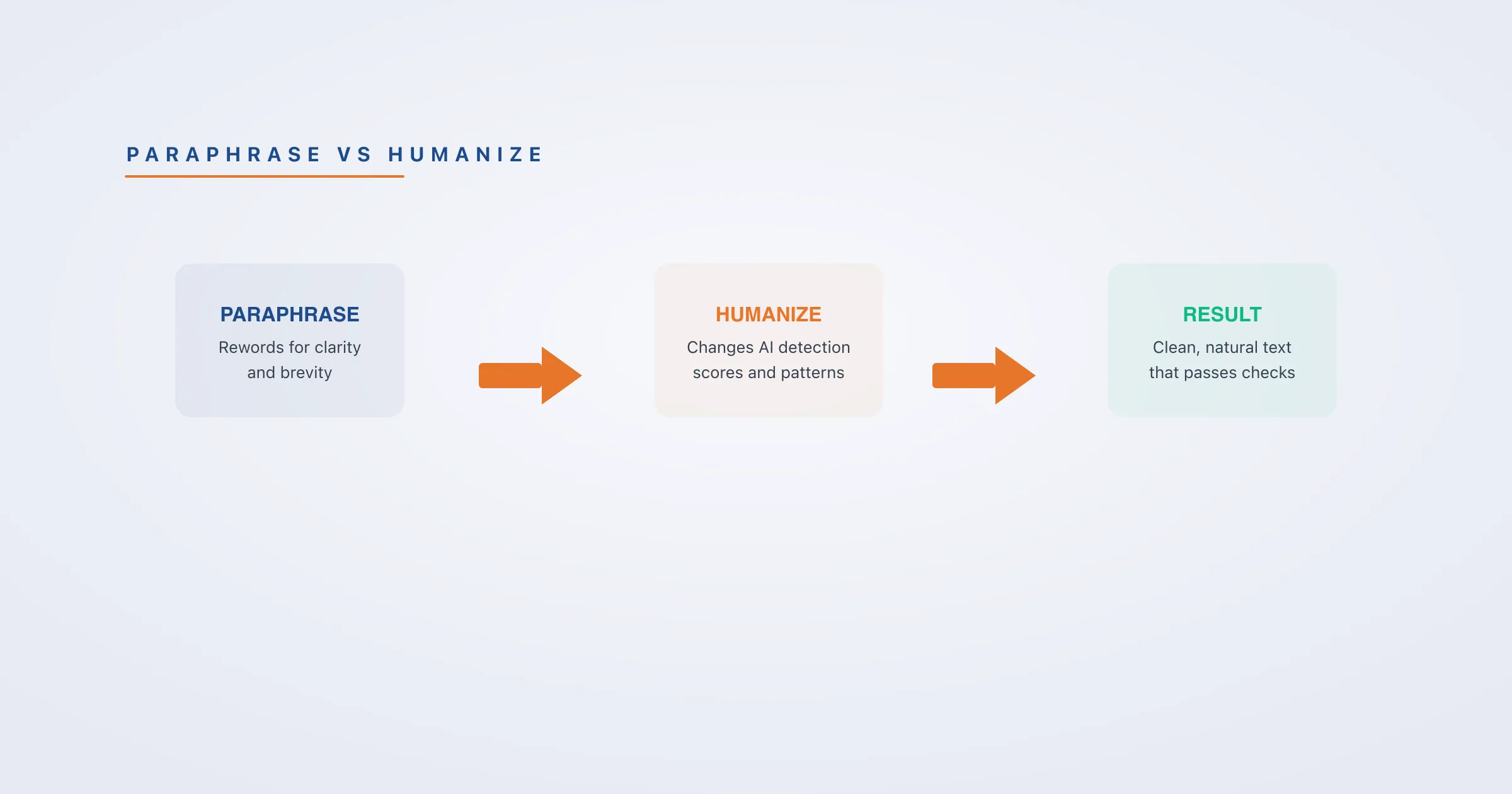
Paraphrasing changes words to reduce text similarity scores. AI humanizing changes statistical patterns (perplexity, burstiness, sentence rhythm) to lower AI detection scores. AI detectors measure patterns, not words — Liang et al. (2023, arXiv:2304.02819) document why these proxies misfire on legitimate ESL writing too.
Paraphrasing
Purpose: Avoid plagiarism detection (text similarity).
How it works: Swaps words and rearranges phrases.
Target: Text similarity checkers (the Turnitin similarity score, plagiarism checkers, originality scanners).
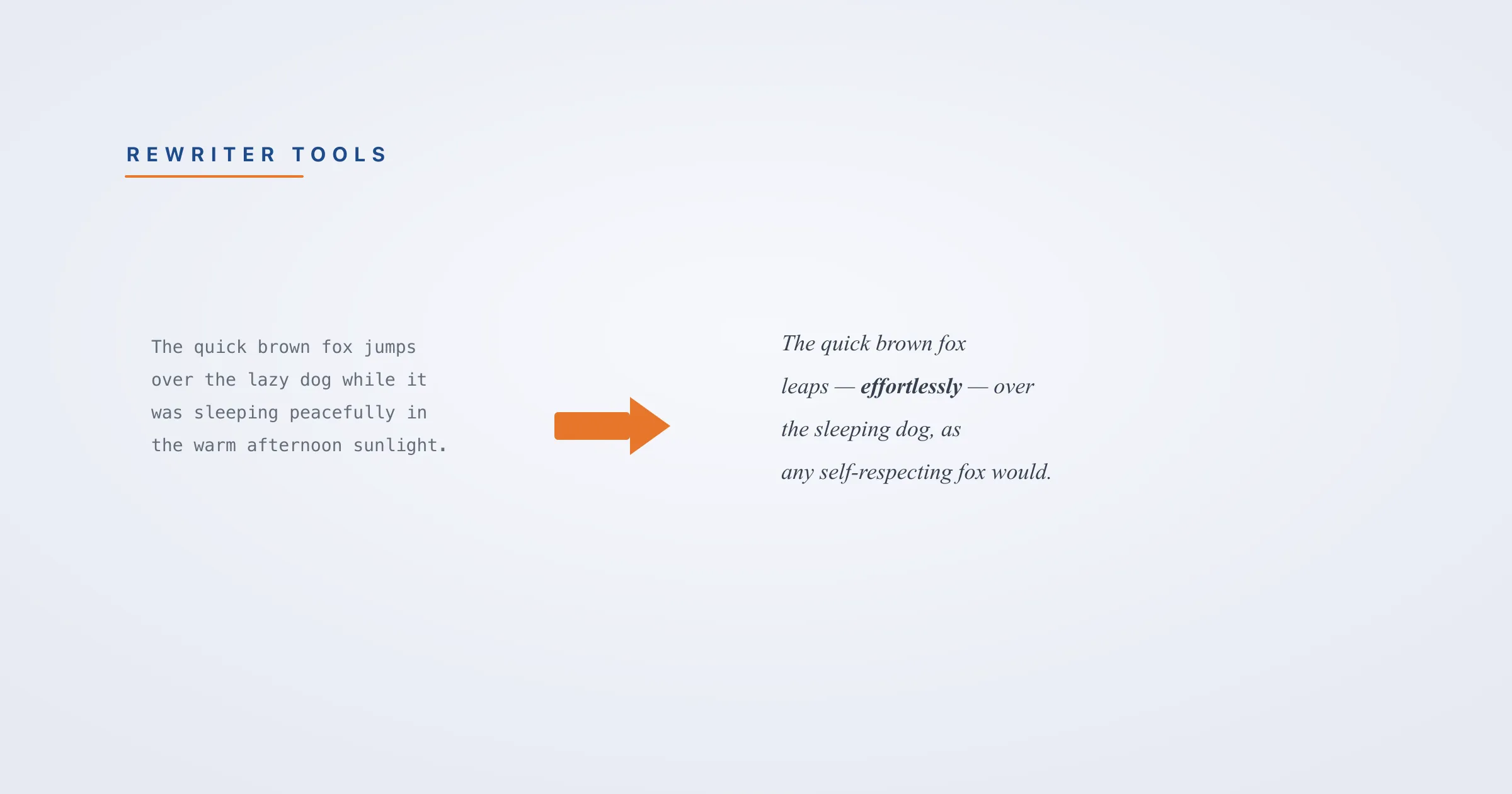
Paraphrasing tools take a sentence and produce a version with different words but the same meaning. The output reads similarly to the input because the goal is to preserve meaning while changing surface text.
AI Humanizing
Purpose: Avoid AI detection (pattern-based).
How it works: Rewrites at the level of perplexity, burstiness, and sentence rhythm.
Target: AI content detectors (GPTZero, Turnitin AI, Copyleaks AI, Winston, Originality.ai).
Humanizing tools rewrite text so the statistical patterns detectors look for shift toward the patterns human writers produce. The output reads differently because it has to vary sentence structure, length, and predictability, not just words.
Rephraser quotas and pricing at a glance
Free tier covers 600 rephrase requests per month with a 20-per-day cap and unlimited words per request. Pro covers 3,000 advanced model requests at $19.99/month. Auto Agent Rephrase batches up to 12,000 words per task.
- Free plan: 600 requests/month, 20/day cap, unlimited Origin model
- Starter ($9.99/mo): unlimited Origin + 1,500 advanced requests (50/day cap)
- Pro ($19.99/mo): 3,000 advanced requests (100/day cap), 80+ languages, API access
- Premium ($29.99/mo): unlimited all models, 100+ languages, 5 Auto Agent credits
- Auto Agent Rephrase add-ons: Mini $3.99 (2,000 words), Pro $6.99 (5,000 words), Max $12.99 (12,000 words)
- Liang et al. 2023 (arXiv:2304.02819) documented over 60% false-positive rates for ESL writers across mainstream GPT detectors
Weber-Wulff et al. 2023 (Int J Educ Integr 19:26) benchmarked 14 detection tools and found none reached the accuracy needed to be considered reliable in academic integrity workflows — most tools either over-flagged human writing or missed machine-paraphrased AI text.
Why don’t paraphrasers bypass AI detection?
Paraphrasers swap synonyms (“important” → “essential” → “crucial”) without changing perplexity or burstiness — the actual signals detectors score. StealthZero’s Sentrio v2 detector (100-word minimum, 4 modes) makes this verifiable: run a QuillBot-paraphrased draft through it and the score barely moves.
The simplest way to see why is to think about what detectors actually measure.
AI detectors don’t look at which words are in your text. They look at:
- How predictable each word is given the words around it (perplexity)
- How much sentence complexity varies across the document (burstiness)
- Whether the text uses AI-typical phrasing
- Whether the structural patterns look like AI output
A paraphraser swaps “important” for “essential” or “crucial.” That doesn’t change perplexity in a meaningful way. The replacement words are still the statistically obvious choices. The sentence structure stays the same. The rhythm stays the same. The detector still sees AI patterns.
A humanizer, by contrast, breaks sentences apart, mixes lengths, swaps in less-predictable vocabulary, and rewrites whole passages so the pattern signature changes. That’s what detectors are actually looking at.
When should you use each tool?
Use paraphrasing for plagiarism-only checks (no AI detection in the pipeline). Use AI humanizing when the receiver runs Turnitin, GPTZero, or Copyleaks. Use both when academic work runs through similarity and AI indicators. StealthZero’s Free tier covers 600 humanizer requests/month with no per-request word cap.
Use Paraphrasing When
- You only have plagiarism checking to worry about (no AI detection in the pipeline)
- You’re rephrasing source material to integrate into a paper with proper citation
- You need to avoid text-similarity matches with other documents
Use AI Humanizing When
- Your content will face AI detection
- You used AI assistance for any part of the draft
- You’re submitting through Turnitin (which now runs both similarity and AI detection)
- You’re publishing somewhere that screens for AI-generated content
Use Both When
- You’re submitting academic work that runs through both similarity and AI checks
- You used AI-generated draft material that incorporates phrasing from external sources
- You’re republishing content and need to address both signals at once
How does StealthZero combine both in one flow?
StealthZero ships AI-pattern rewriting with original output (so no new plagiarism signals), five rewrite models, locked phrases for citations, and four-detector Proof Reports. The Cohera Jarvis sub-model achieves 100% bypass in internal testing; the base humanizer targets 99% pass-rate, and the Auto Agent Rephrase add-on batches up to 12,000 words per task.
The StealthZero humanizer is designed for the second case: AI-pattern rewriting, with the output staying original (not lifted from external sources, so it doesn’t introduce new plagiarism signals).
A few things worth knowing:
- The free Origin model gives unlimited rewrites with no advanced-model credits used
- Higher tiers (Sentinel-Lite, Sentinel-Max, F.R.I.D.A.Y, Jarvis) give stronger pass rates against tougher detectors
- The Cohera model (a Jarvis sub-model) achieves 100% bypass in StealthZero’s internal testing; the base flow targets 99%
- You can lock phrases, citations, and key terms so the humanizer doesn’t change them while rewriting everything else
For verification before you submit, the StealthZero AI detector gives you a sentence-level breakdown of how the humanized output reads. For the same Turnitin report your professor will see, the Turnitin checker generates the official report on your draft.
Bottom Line
Paraphrasing changes words. Humanizing changes patterns. AI detectors care about patterns, not words.
If you’re using a tool to get past plagiarism checking, a paraphraser is the right category. If you’re using a tool to get past AI detection, you need a humanizer. Tools that promise both at once need to actually rewrite at the pattern level, not just swap synonyms.
For background, see our guides on perplexity in AI detection, burstiness, and how GPTZero works. For Turnitin specifically, see the Turnitin AI writing report guide.
References
- Liang, W., Yuksekgonul, M., Mao, Y., Wu, E., & Zou, J. (2023). “GPT detectors are biased against non-native English writers.” arXiv:2304.02819. https://arxiv.org/abs/2304.02819
- Sadasivan, V. S., Kumar, A., Balasubramanian, S., Wang, W., & Feizi, S. (2023). “Can AI-Generated Text Be Reliably Detected?” arXiv:2303.11156. https://arxiv.org/abs/2303.11156
- Weber-Wulff, D., Anohina-Naumeca, A., Bjelobaba, S., et al. (2023). “Testing of detection tools for AI-generated text.” International Journal for Educational Integrity, 19(1). https://doi.org/10.1007/s40979-023-00146-z
Updated 2026-05-28.
Frequently Asked Questions
What's the difference between paraphrasing and AI humanizing?
Paraphrasing changes words and phrases to avoid plagiarism detection. AI humanizing changes underlying writing patterns (perplexity, burstiness, sentence rhythm) to avoid AI detection. They target different signals and they're used for different problems.
Can paraphrasing tools bypass AI detection?
Generally no, or only weakly. Paraphrasers like QuillBot swap words but leave the underlying patterns AI detectors look for (low perplexity and burstiness) largely intact. AI humanizers rewrite at the pattern level, which is what detectors actually measure.
Do I need both paraphrasing and humanizing?
If your content will face AI detection, you need humanizing. If only plagiarism checking, paraphrasing is enough. StealthZero's humanizer does both at once: it rewrites for human-like patterns and doesn't pull text from external sources, so the output is original.
Which tool should I use if I'm writing a paper?
If you used AI assistance and your professor uses Turnitin (which now includes AI detection), you want a humanizer. A paraphraser alone changes the surface words but leaves the AI-pattern signature in place, so the AI report can still flag it.