AI Rephraser · guides
Humanizer Rewriter: Rewriting AI Text for Detection Bypass (2026)
A humanizer rewriter combines paraphrasing with detection bypass. Here is how it differs from regular paraphrasers, which tools do it well, and the workflow

A humanizer rewriter is a tool that does more than swap synonyms. It rewrites AI-generated text specifically to change the statistical patterns that AI detectors measure. The result reads naturally and passes detection checks that a regular paraphraser would not.
Sadasivan et al. 2023 (arXiv:2303.11156) showed that even the strongest AI text detectors degrade toward random-chance accuracy under light paraphrasing attacks, suggesting a theoretical ceiling on reliable detection of high-quality AI text.
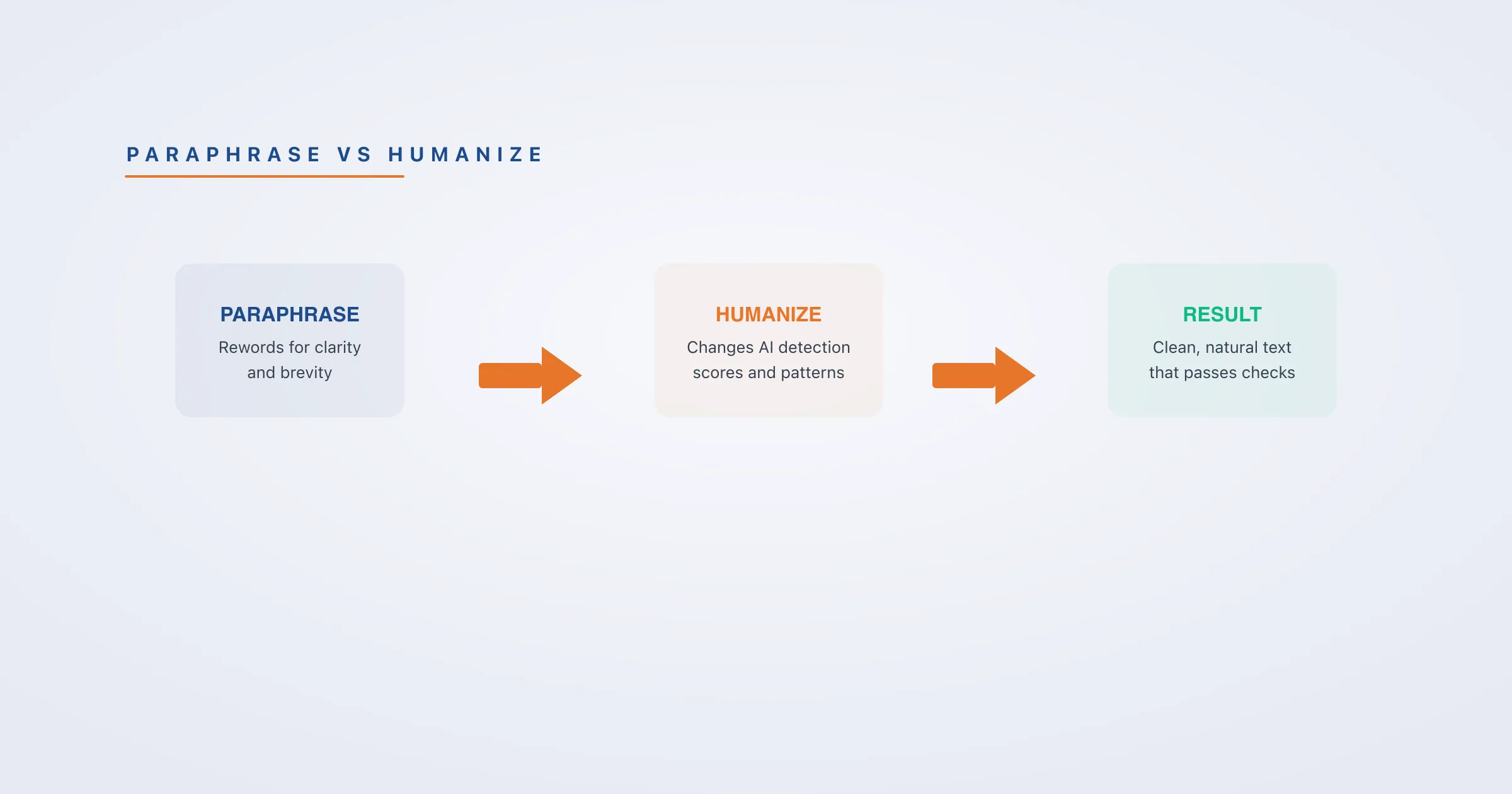
This distinction matters. If you have ever run ChatGPT text through a paraphraser and watched the detector still flag it, you have seen the problem firsthand. A paraphraser changes words. A humanizer rewriter changes how the text reads to a detector.
What is the difference between a paraphraser and a humanizer rewriter?
A paraphraser swaps synonyms to change wording; a humanizer rewriter targets the perplexity and burstiness signals AI detectors score. Liang et al. (2023, arXiv:2304.02819) document why pattern-level rewrites move detector scores and synonym swaps do not.
These two tool categories look similar on the surface but operate differently under the hood. Here is the breakdown.
| Aspect | Paraphraser | Humanizer Rewriter |
|---|---|---|
| Primary goal | Change wording for clarity, variety, or plagiarism avoidance | Change statistical patterns to bypass AI detection |
| Targets | Synonyms, sentence structure, word order | Perplexity, burstiness, vocabulary fingerprints |
| Detector awareness | None. Does not know or care about AI detectors | Built to defeat specific detection algorithms |
| Typical tools | QuillBot, Wordtune, Grammarly paraphrase | StealthZero, Undetectable AI, StealthGPT |
| Effect on detector scores | Minimal. Often no change or worse | Intentional reduction of AI-probability scores |
| Best for | Improving readability, avoiding plagiarism overlap | Making AI text pass detection checks |
For a deeper dive into this distinction, see our paraphrase vs. humanize comparison.
The core difference comes down to what the tool is optimizing for. A paraphraser optimizes for readability and variety. A humanizer rewriter optimizes for detection evasion while maintaining readability as a constraint.
Perplexity and Burstiness
AI detectors measure two main signals. Perplexity tracks how predictable each word is given the preceding words. AI text has low perplexity because language models pick statistically likely words. Human text has higher perplexity because people make unexpected word choices.
Burstiness measures variation in sentence length and complexity. AI text tends toward uniform sentence structure. Human writing mixes short punchy sentences with longer complex ones. This variation is what detectors look for as a human signal.
A paraphraser may incidentally change these values, but it is not designed to. A humanizer rewriter targets them directly.
Rephraser quotas and pricing at a glance
Free tier covers 600 rephrase requests per month with a 20-per-day cap and unlimited words per request. Pro covers 3,000 advanced model requests at $19.99/month. Auto Agent Rephrase batches up to 12,000 words per task.
- Free plan: 600 requests/month, 20/day cap, unlimited Origin model
- Starter ($9.99/mo): unlimited Origin + 1,500 advanced requests (50/day cap)
- Pro ($19.99/mo): 3,000 advanced requests (100/day cap), 80+ languages, API access
- Premium ($29.99/mo): unlimited all models, 100+ languages, 5 Auto Agent credits
- Auto Agent Rephrase add-ons: Mini $3.99 (2,000 words), Pro $6.99 (5,000 words), Max $12.99 (12,000 words)
- Liang et al. 2023 (arXiv:2304.02819) documented over 60% false-positive rates for ESL writers across mainstream GPT detectors
Weber-Wulff et al. 2023 (Int J Educ Integr 19:26) benchmarked 14 detection tools and found none reached the accuracy needed to be considered reliable in academic integrity workflows — most tools either over-flagged human writing or missed machine-paraphrased AI text.
QuillBot as a Humanizer Rewriter
QuillBot is primarily a paraphrasing tool. It recently added a humanizer feature, which positions it as both a paraphraser and a humanizer rewriter. Here is what the data shows.
Free tier: QuillBot’s free plan allows humanization of up to 125 words per input, with 6 uses per day. For anything longer than a short paragraph, you will need the Premium plan.
Premium pricing: $8.33/month on an annual plan. This unlocks higher word limits and more features.
Limitations: QuillBot’s humanizer is a newer addition to a paraphrasing-first platform. It was not built from the ground up for detection bypass. If you need to humanize academic text with citations, or if you need to verify the output against multiple detectors, QuillBot does not include those features.
For a full comparison, see our StealthZero vs. QuillBot breakdown.
How does StealthZero work as a purpose-built humanizer rewriter?
StealthZero was designed from the ground up for detector bypass with five rewrite models, locked phrases, two detector engines (E.D.I.T.H + Sentrio v2 with a 100-word minimum), and four-detector Proof Reports. The Free tier ships 600 requests/month (20/day cap) with unlimited words per request on Origin — no card required.
StealthZero was designed specifically as a humanizer rewriter, not a paraphraser that added humanization later. Every feature is oriented around detection bypass with readability as a baseline requirement.
Multiple Rewrite Models
Different detectors respond to different rewrite strategies. StealthZero offers multiple models so you can choose the right approach:
- Origin: Unlimited use, no advanced credits. Good for general rewriting.
- Sentinel-Lite and Sentinel-Max: Mid-tier models with different approaches to pattern modification.
- F.R.I.D.A.Y: Advanced rewriting with stronger pattern disruption.
- Jarvis sub-models (Homer, Cohera, Max): Specialized models for different use cases. The Cohera model achieves 100% bypass in internal testing.
Tone Controls
Output should match the context. StealthZero offers Neutral, Casual, and Academic tones depending on the model you select. Academic tone is specifically calibrated for essay and research paper language.
Locked Phrases
When rewriting for academic purposes, your citations and references need to remain untouched. Locked phrases let you mark specific text as off-limits before the rewrite. This prevents the humanizer from altering author names, years, or direct quotes.
Built-in Detection
StealthZero includes two detection systems. E.D.I.T.H has no minimum word count and works for quick checks. Sentrio v2 offers four modes: Standard, Aggressive, Multilingual, and Scholar. The Scholar mode is tuned for academic text.
Proof Reports
For academic submissions, StealthZero generates a PDF Proof Report that includes detection scores from Turnitin, GPTZero, Winston AI, and CopyLeaks. This gives you documented verification before you submit.
No Word Limit Per Request
Unlike QuillBot’s 125-word free cap, StealthZero has no per-request word limit on any plan. The free tier includes 600 requests per month (20 per day cap) with the Origin model.

What is the humanize-then-verify workflow?
Five steps: generate or gather the AI text, run it through the humanizer with locked phrases, verify against built-in detection, generate a four-detector Proof Report for academic use, then read the output and edit by hand. The Pro tier gives 2 Proof Reports/month plus 3,000 advanced model requests/month for ongoing academic work.
The right process matters as much as the right tool. Here is the workflow that produces reliable results.
Step 1: Generate or Gather Your AI Text
Write your content using ChatGPT, Claude, or any AI tool. Focus on getting the substance right. Do not worry about detection at this stage.
Step 2: Run It Through the Humanizer Rewriter
Paste the full text into StealthZero’s humanizer. Select the model and tone that match your use case. For academic work, choose Cohera or another advanced model with Academic tone. Lock any citations or proper nouns using the locked phrases feature.
Step 3: Verify with Built-in Detection
Before doing anything else, run the output through StealthZero’s built-in detector. Check the scores across multiple detection engines. If the scores are not where you need them, try a different model or adjust your input.
Step 4: Generate a Proof Report (Academic Use)
If you are submitting academic work, generate a Proof Report. This PDF shows detection scores from Turnitin, GPTZero, Winston AI, and CopyLeaks in one document. You know exactly what your professor’s detection report will show before you submit.
Step 5: Read the Output
This step is non-negotiable. Read the humanized text yourself. Make sure it still says what you intended. Fix any awkward phrasing. Add your own voice where it feels generic. The humanizer rewriter does the heavy lifting, but the final pass should be yours.
For more on this workflow, see our guide on how to humanize ChatGPT text.
When a Paraphraser Is Enough
Not every situation calls for a humanizer rewriter. If you are:
- Rewriting your own human text for clarity or variety
- Paraphrasing source material to avoid plagiarism (with citation)
- Adjusting tone for a different audience
A paraphraser like QuillBot does the job. Detection bypass is not the goal in these cases.
But if you are working with AI-generated text and need it to pass detection checks, a paraphraser is the wrong tool. You need a humanizer rewriter that targets the specific patterns detectors measure.
Choosing the Right Tool
Your choice comes down to what you need the output to do.
If you need to pass AI detection: Use a purpose-built humanizer rewriter like StealthZero. The free tier is enough to test whether it works for your text before paying.
If you just need to rephrase for clarity: A paraphraser like QuillBot is fine. The free tier handles short passages, and Premium at $8.33/month covers longer ones.
If you need both: StealthZero handles detection bypass with built-in paraphrasing capability. You do not need two separate tools.
For more on AI rewriting tools and how they compare, see our AI rewriter tools guide.
To try the humanizer rewriter workflow yourself, start with the StealthZero free tier. Full pricing is on the pricing page.
References
- Liang, W., Yuksekgonul, M., Mao, Y., Wu, E., & Zou, J. (2023). “GPT detectors are biased against non-native English writers.” arXiv:2304.02819. https://arxiv.org/abs/2304.02819
- Sadasivan, V. S., Kumar, A., Balasubramanian, S., Wang, W., & Feizi, S. (2023). “Can AI-Generated Text Be Reliably Detected?” arXiv:2303.11156. https://arxiv.org/abs/2303.11156
- Weber-Wulff, D., Anohina-Naumeca, A., Bjelobaba, S., et al. (2023). “Testing of detection tools for AI-generated text.” International Journal for Educational Integrity, 19(1). https://doi.org/10.1007/s40979-023-00146-z
Frequently Asked Questions
Is a humanizer rewriter the same as a paraphraser?
No. A paraphraser changes wording for clarity or variety. A humanizer rewriter specifically targets the statistical patterns AI detectors measure — perplexity, burstiness, and vocabulary fingerprints. Paraphrasers like QuillBot may improve readability but rarely change a detector verdict.
Can QuillBot humanize AI text?
QuillBot has a humanizer feature on its Premium plan. The free tier allows 125-word humanization with 6 uses per day. QuillBot's humanizer is newer and less specialized than tools built specifically for detection bypass like StealthZero.
What is the best humanizer rewriter tool?
StealthZero is built specifically as a humanizer rewriter with multiple models, tone controls, locked phrases for citations, and built-in detector verification. The Cohera model achieves 100% bypass in [internal testing](/blog/ai-humanizer/our-methodology-1000-essays/). The free tier includes 600 requests per month with no word cap.
How is rewriting for detection bypass different from normal rewriting?
Normal rewriting focuses on clarity, style, or avoiding plagiarism. Rewriting for detection bypass targets specific signals: increasing word unpredictability (perplexity), varying sentence length (burstiness), and removing AI-associated vocabulary patterns. The goal is different, so the tool needs to be different.